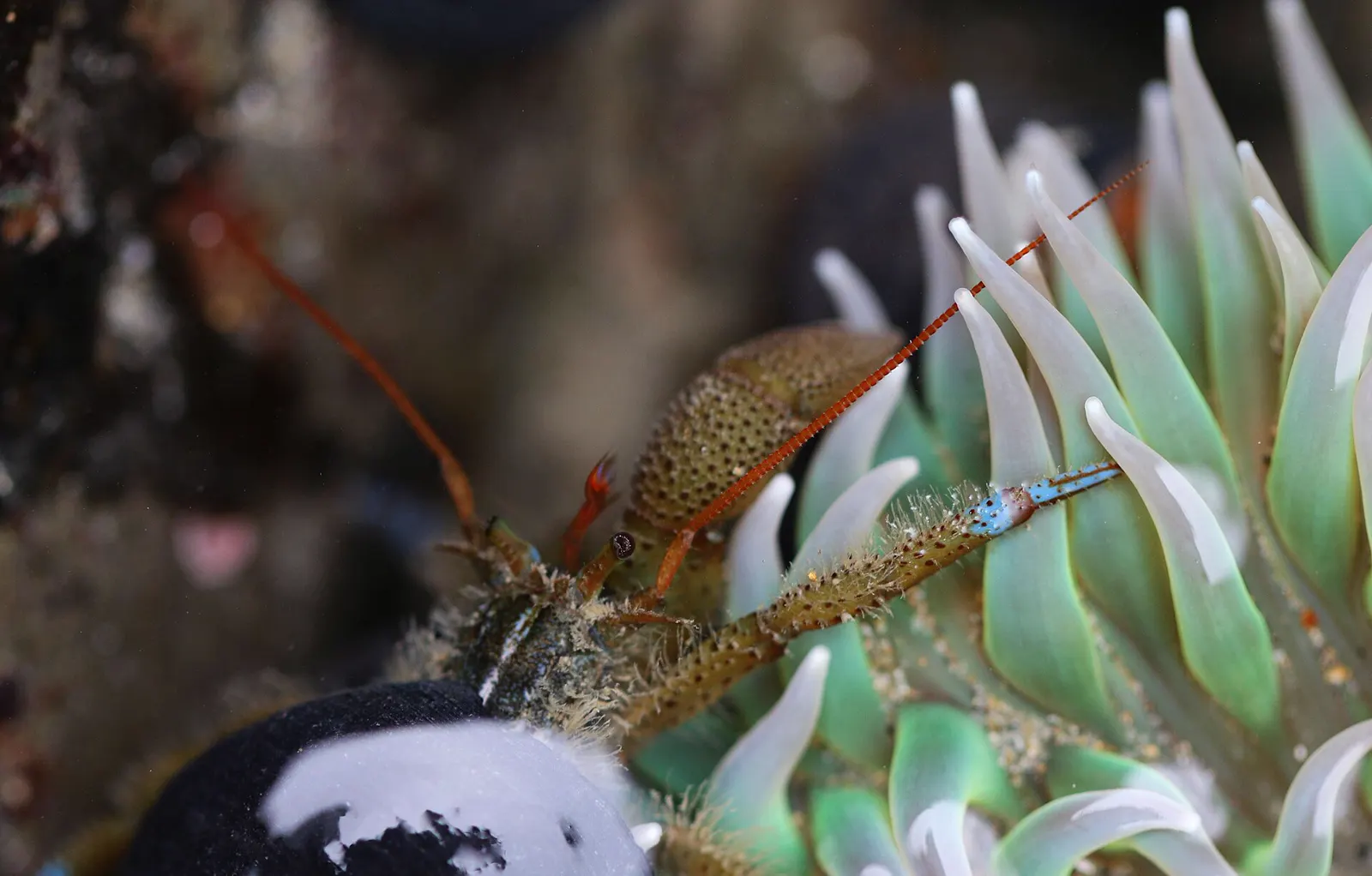
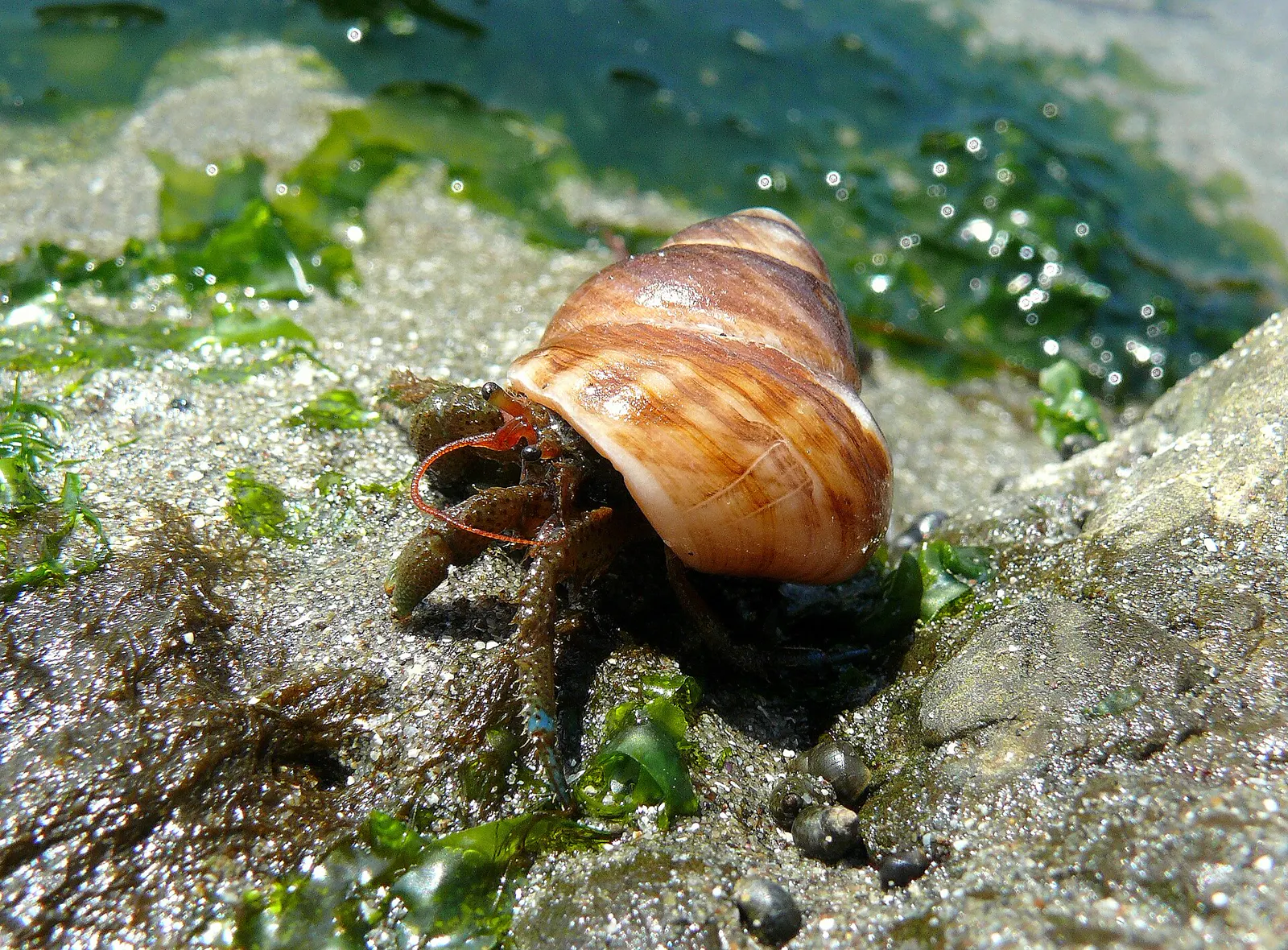
A blue-banded hermit crab (Pagurus samuelis) in a snail shell

Animal group

Hermit crabs of the Pacific coast

Scientific group: Family Paguridae (infraorder Anomura)1

Hermit crabs are among the animals visitors may see in the rocky intertidal at Cabrillo National Monument.2 Empty Tegula (black turban snail) shells are a favourite home for hermit crabs.3

A blue-banded hermit crab (Pagurus samuelis) in a snail shell. Location: not recorded. Photo: Peter Pearsall / U.S. Fish and Wildlife Service (USFWS - Pacific Region) (opens in a new tab) · Public domain

Varieties

The main kinds you might see. Each photo is identified as that species in its own record; tap a photo to see it full size.

Blue-banded hermit crab (Pagurus samuelis)

Blue-banded hermit crab

Pagurus samuelis1

  • Pagurus samuelis is dark olive green, with red antennae without bands and patches of blue on the tips of its legs. Small juveniles often have white bands on their legs.1
  • Many hermit crab species occur in tidepools. P. samuelis lacks the blue or white bumps on its legs and claws that P. granosimanus has.1

Learn more: Wikipedia: Pagurus samuelis (opens in a new tab)

Photo: Linda Tanner (opens in a new tab) · CC BY 2.0 (opens in a new tab), resized

Granular hermit crab

Pagurus granosimanus1

  • Pagurus granosimanus is also dark olive green, with red-orange antennae and blue or white wart-like bumps, especially on its claws and walking legs.1
  • Many hermit crab species occur in tidepools. P. samuelis lacks the blue or white bumps on its legs and claws that P. granosimanus has.1

Learn more: Wikipedia: Pagurus granosimanus (opens in a new tab)

Where and when to find it

  • Pagurus samuelis is described as the most common hermit crab in tidepools, living in the high to mid intertidal on sheltered outer coast.1
  • Pagurus granosimanus is common in tidepools from the lower mid intertidal down into the subtidal.1

How it lives

  • Pagurus samuelis prefers turban snail shells.1
  • Hermit crabs can sometimes be seen scavenging among dense sea grasses.4

How to watch without harming it

  • Be respectful, avoid disturbing animals' homes, and touch only with two fingers.3
  • At Cabrillo, collecting anything, including shells, living or dead animals and rocks, is forbidden.5
  • Don't chase or pick up an animal that is moving away, hiding or resisting being handled.5
  • If you do pick up an animal to look at it, put it back exactly where you found it. That spot is its home territory.6

Range

  • Pagurus samuelis ranges from Vancouver Island to Baja California.1
  • Pagurus granosimanus ranges from the Aleutian Islands, Alaska, to Baja California.1

Where the agencies name them

Spots whose managing agency lists hermit crabs for that place.

Further reading

For exploring further. These pages are not sources for the facts above; those are listed under Sources.

Sources

  1. Stanford University, Hopkins Marine Station (Stanford SeaNet): Crustaceans - crabs, shrimp, isopods, amphipods (opens in a new tab) · accessed 17 November 2026
  2. National Park Service, Cabrillo National Monument: Tidepool Wayside Display (opens in a new tab) · page updated 20 February 2024 · accessed 17 November 2026
  3. National Park Service, Cabrillo National Monument: Intertidal Field Guide (opens in a new tab) · page updated 25 June 2021 · accessed 17 November 2026
  4. National Park Service, Olympic National Park: Tidal Life (opens in a new tab) · page updated 8 November 2024 · accessed 17 November 2026
  5. National Park Service: Cabrillo National Monument: The Rocky Intertidal Zone (opens in a new tab) · page updated 31 October 2026 · accessed 17 November 2026
  6. National Park Service, Channel Islands National Park: Tidepooling (opens in a new tab) · page updated 26 May 2016 · accessed 17 November 2026

Last checked 17 November 2026 against the sources above.