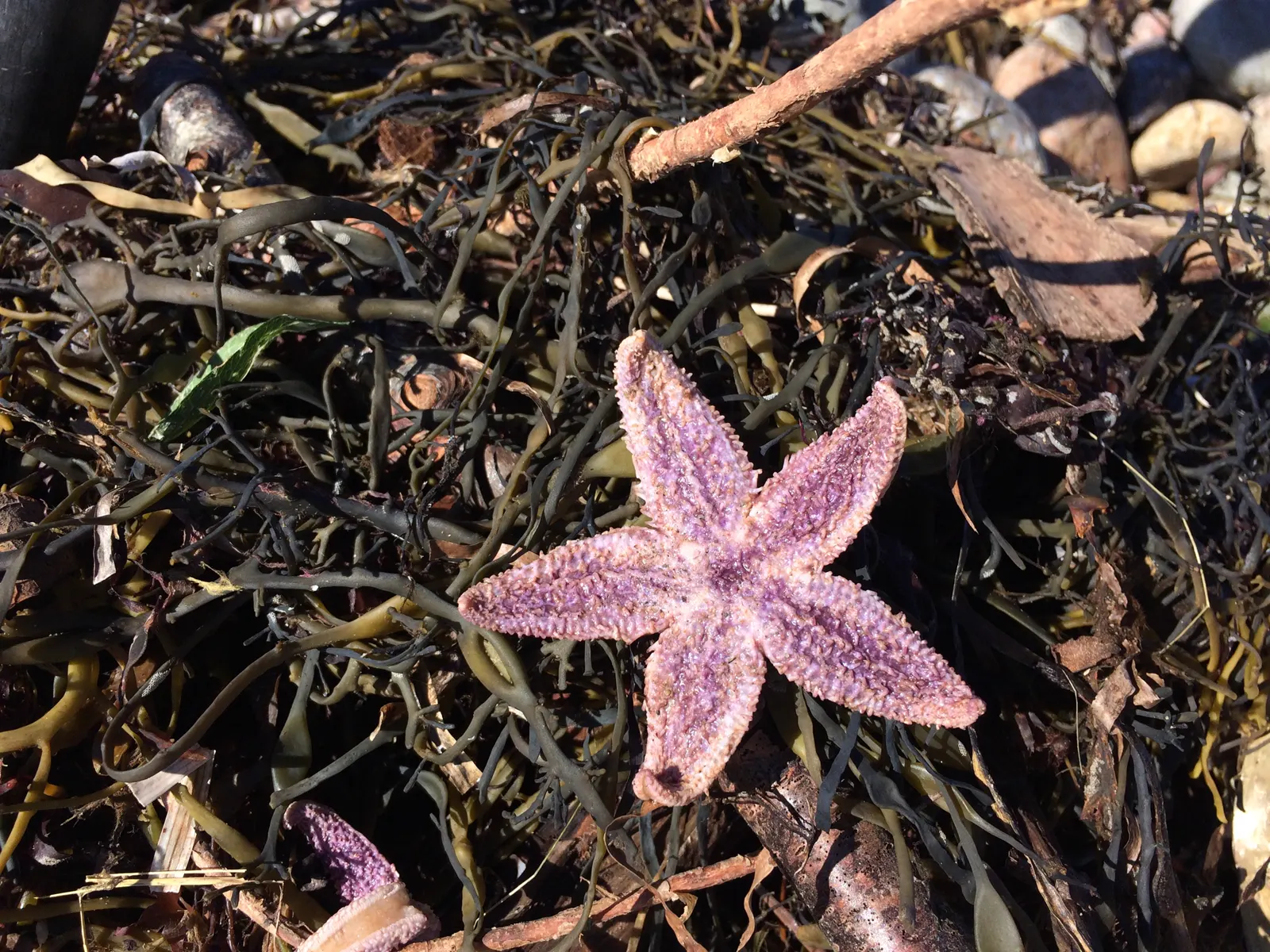
A purple northern sea star lying on brown seaweed at low tide

Species

Northern sea star (Atlantic coast)

Asterias rubens1

The northern sea star lives in Acadia's lower intertidal zone, on rocks and in tidepools. Higher up, it would dry out in the sun at low tide (NPS).1 It eats mussels, clams and other bivalves, barnacles and sea snails, prying shells open with its tube feet (NPS).1

A northern sea star (Asterias rubens). Location: Nova Scotia, Canada. Photo: Anonymous ebirder (iNaturalist) (opens in a new tab) · CC BY-SA 4.0 (opens in a new tab), resized

What it looks like

  • Look for white spines on its skin, and a red eye spot at the end of each arm that senses light and dark (NPS).1
  • Underneath, each arm has four rows of tube feet in an open groove (NPS).1

Where and when to find it

  • The lower intertidal zone, on rocks and in tidepools, and deeper in the always-underwater subtidal zone (NPS).1

How it lives

  • It pushes its stomach out through its mouth onto its prey, digests the meal, then pulls its stomach back in (NPS).1
  • Crabs, lobsters, bottom-dwelling fish, other sea stars and gulls eat sea stars. A sea star can let go of a grabbed arm to escape, and regrow it (NPS).1
  • It would take a sea star about a week to travel one mile (NPS).1

How to watch without harming it

  • In Acadia National Park, collection is prohibited: leave the park as you found it.2
  • Never use force to remove anything, and put animals back where you find them (NPS Acadia).2

Where the agencies name it

Spots whose managing agency lists northern sea star for that place.

Sources

  1. National Park Service: Creature Feature: Sea Stars (Acadia National Park) (opens in a new tab) · accessed 18 November 2026
  2. National Park Service (Acadia National Park): Tidepooling (opens in a new tab) · accessed 18 November 2026

Last checked 18 November 2026 against the sources above.