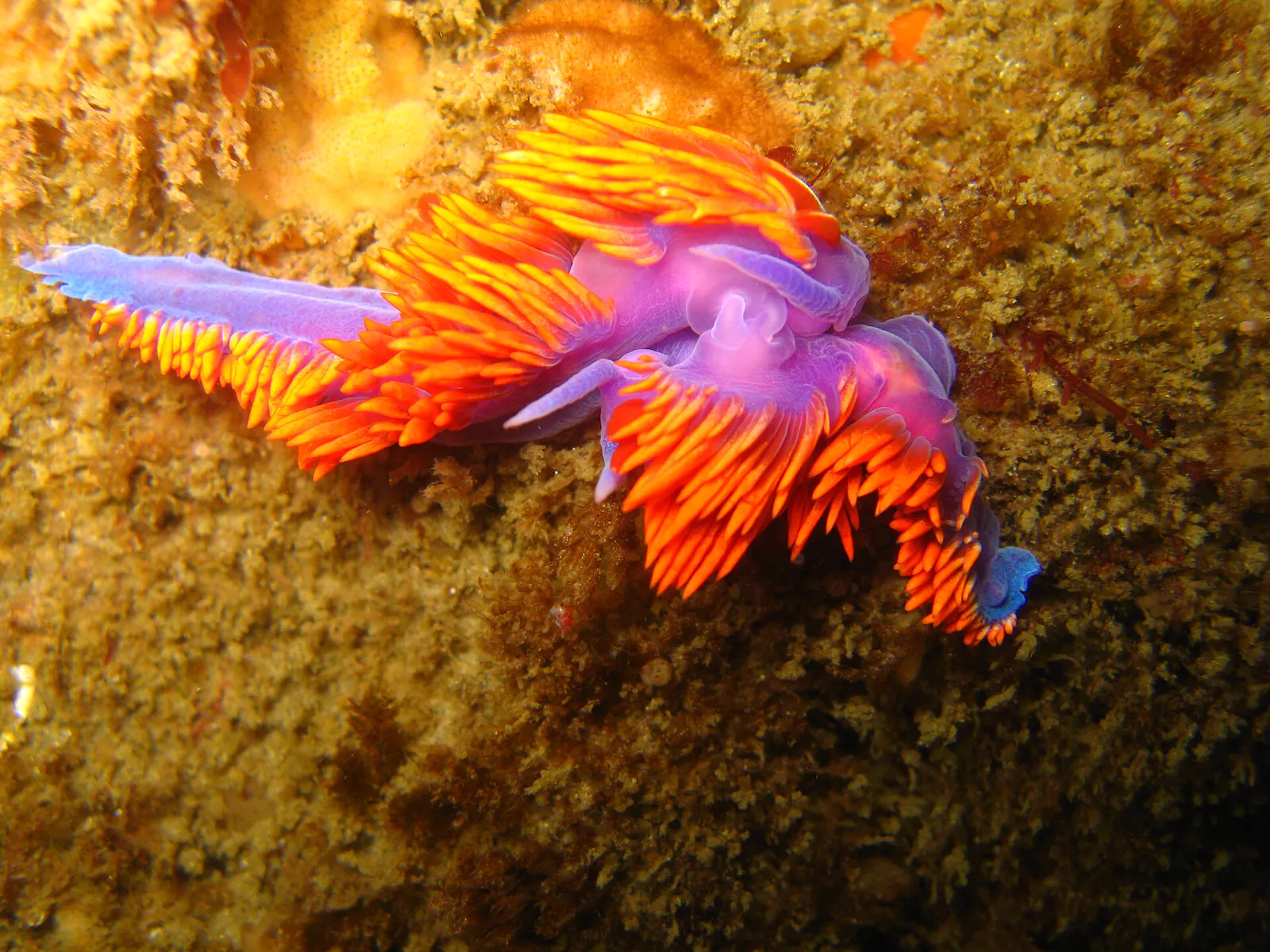
Two Spanish shawl nudibranchs (Flabellinopsis iodinea), purple with orange plumes, on a rock

Animal group

Sea slugs and nudibranchs of the Pacific coast

Scientific group: Shell-less marine gastropods (molluscs); nudibranchs are one well-known subgroup1

Nudibranchs, sometimes called sea slugs, are among the most eye-catching animals in a tidepool.2 They live in the low intertidal zone, which is uncovered only during the lowest tides.3

A pair of Spanish shawl nudibranchs (Flabellinopsis iodinea). Location: Leo Carrillo State Beach, Malibu, California. Photo: Steven Thomas Snyder (Series8217 at English Wikipedia) (opens in a new tab) · CC BY-SA 3.0 (opens in a new tab), resized

Varieties

The main kinds you might see. Each photo is identified as that species in its own record; tap a photo to see it full size.

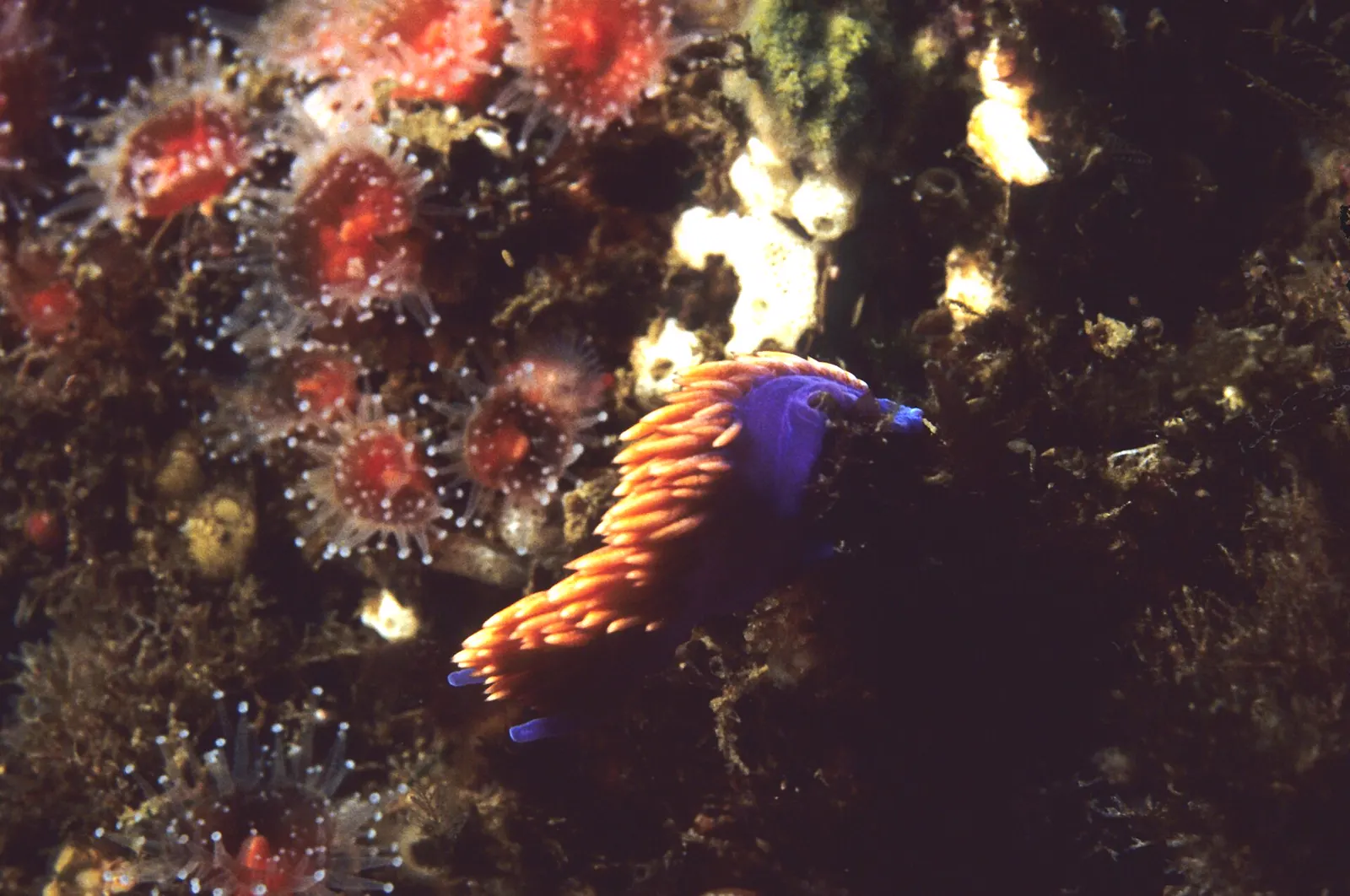
Spanish shawl (Flabellinopsis iodinea)

Spanish shawl

Flabellinopsis iodinea4

  • The Spanish shawl has a see-through purple body with bright orange cerata rising from its back.4
  • The Spanish shawl also lives below the tide line, to depths of about 27 metres.4

Learn more: Wikipedia: Flabellinopsis iodinea (opens in a new tab)

Photo: Dr. Dwayne Meadows, NOAA/NMFS/OPR. (opens in a new tab) · Public domain
Hopkins' rose nudibranch (Okenia rosacea)

Hopkins' rose nudibranch

Okenia rosacea1

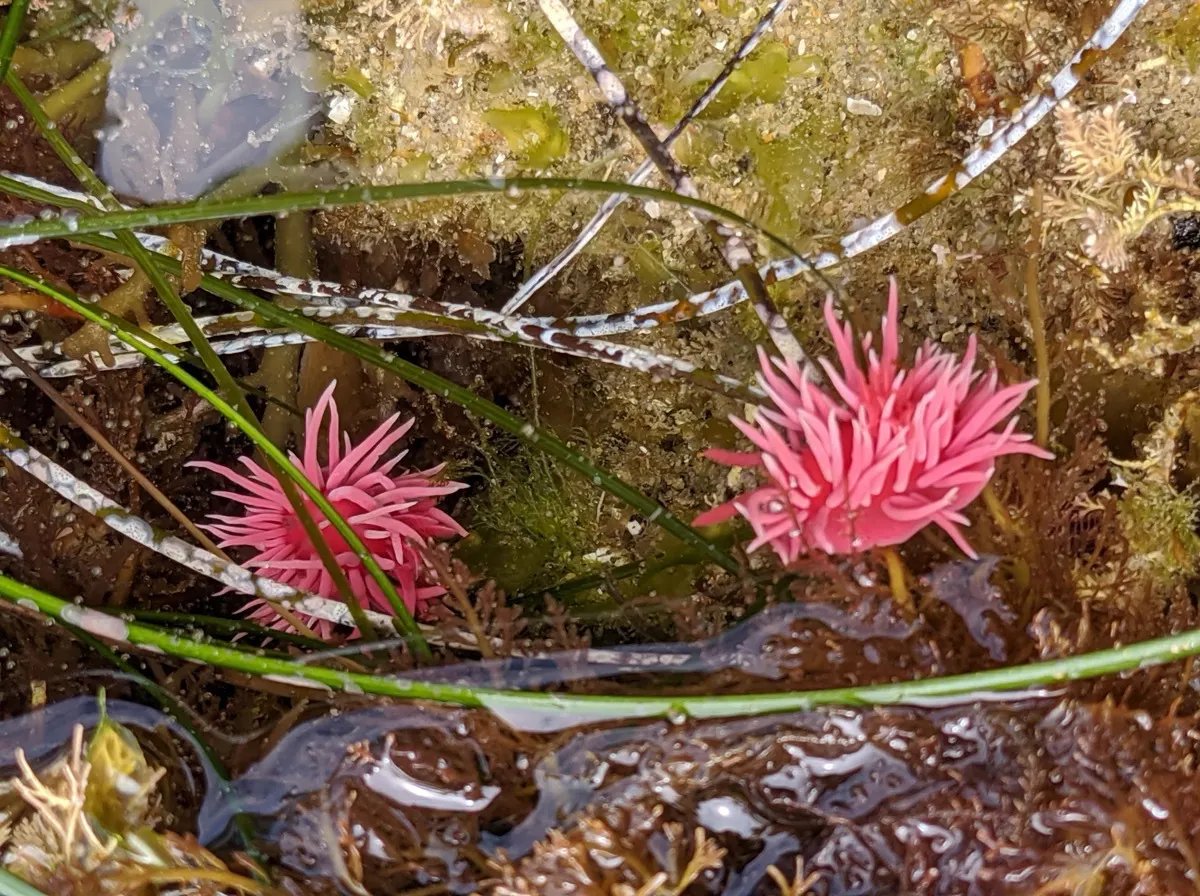
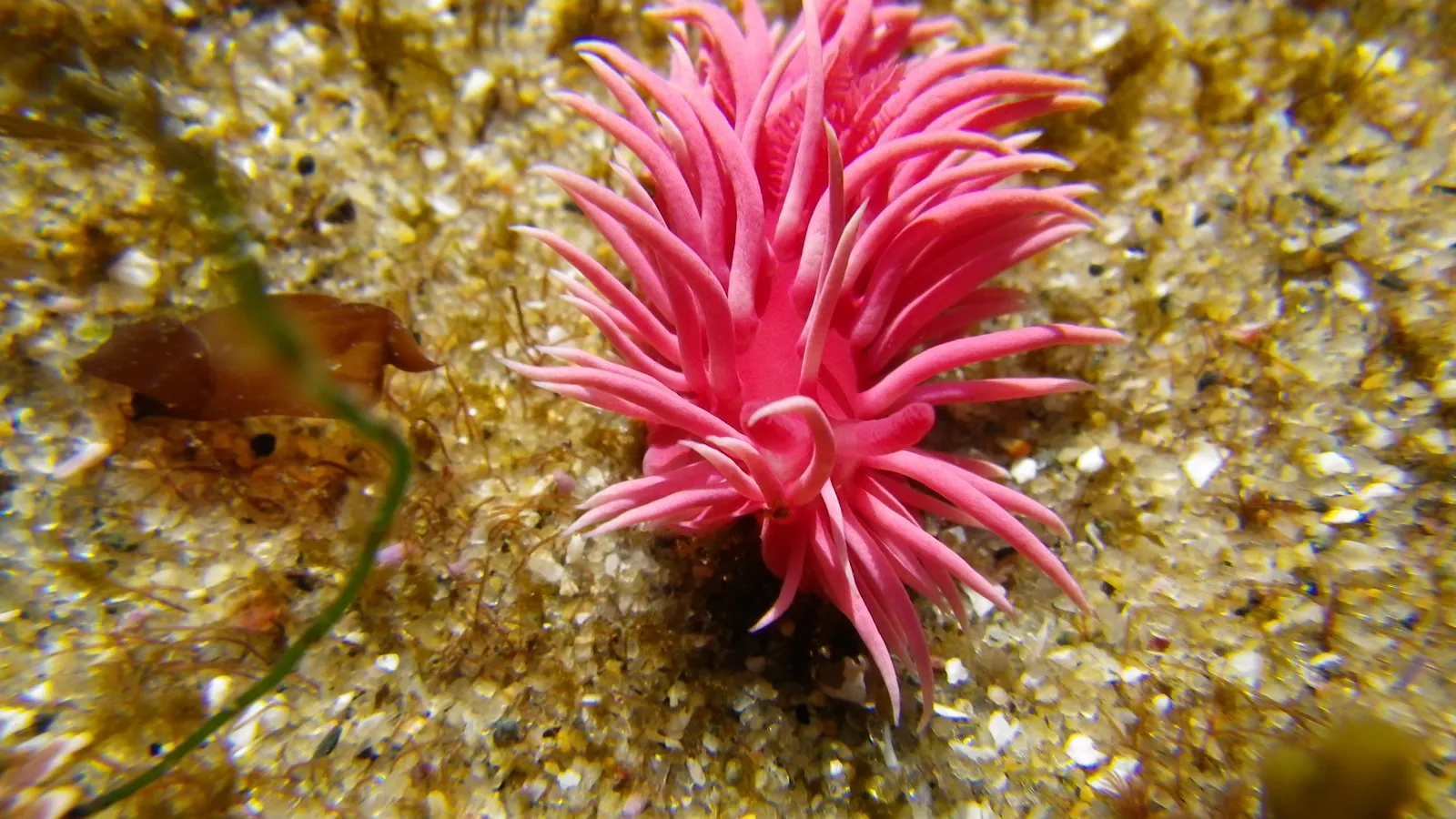
  • The rosy (Hopkins' rose) nudibranch is vivid red and pink and about 1 inch long.5
  • Rosy nudibranchs are often found in seagrass or on rocks in low pools.5

Learn more: Wikipedia: Ceratodoris rosacea (opens in a new tab)

Photo: Phish92129 (opens in a new tab) · CC BY-SA 3.0 (opens in a new tab), resized

What it looks like

  • Nudibranchs come in many bright colours and patterns, often with odd fronds hanging from the body.2
  • Nudibranchs carry their gills on the outside of the body, one of the features that sets them apart from other sea slugs.1

Where and when to find it

  • On the Washington coast, Olympic National Park lists nudibranchs among the seldom-seen animals of the low tide zone.6

How it lives

  • Some nudibranchs eat parts of sea anemones but keep the anemones' stinging cells for their own use.2
  • Hopkins' rose nudibranchs are carnivores. They use sensory organs called rhinophores to find their only food, a pink encrusting bryozoan.1
  • One local dorid nudibranch takes hard spicules from the sponges it eats and uses them to defend itself against predators.5
  • Like many other sea slugs, the Spanish shawl is a hermaphrodite. It rarely fertilises itself and mates only when another nudibranch is nearby.4

How to watch without harming it

  • If you touch a sea slug at all, touch it as gently as you would your own eye.3
  • Few tidepool animals can harm people, but many can be hurt or even killed when handled or touched.7
  • Look at the base of rocks, but don't turn any over.8

Range

  • More than 2,000 nudibranch species are known in seas around the world, from the deep sea floor to intertidal pools.1
  • For example, the Hopkins' rose nudibranch has historically ranged from northern Baja California, Mexico, to the lower Oregon coast.1

More photos

Two Hopkins' rose nudibranchs (bright pink, frilly)
Two Hopkins' rose nudibranchs (bright pink, frilly). Location: not recorded.Photo: NPS Photo (opens in a new tab) · Public domain

Where the agencies name them

Spots whose managing agency lists sea slugs and nudibranchs for that place.

Further reading

For exploring further. These pages are not sources for the facts above; those are listed under Sources.

Sources

  1. National Park Service, Cabrillo National Monument: That Which is Bright and Splendid (park blog) (opens in a new tab) · page updated 24 June 2017 · accessed 17 November 2026
  2. National Park Service, Point Reyes National Seashore: Intertidal and Subtidal Zones (opens in a new tab) · page updated 4 February 2024 · accessed 17 November 2026
  3. National Park Service: Cabrillo National Monument: The Rocky Intertidal Zone (opens in a new tab) · page updated 31 October 2026 · accessed 17 November 2026
  4. National Park Service, Cabrillo National Monument: Dancing with the Spanish Shawl (park blog) (opens in a new tab) · page updated 30 January 2018 · accessed 17 November 2026
  5. National Park Service, Cabrillo National Monument: Intertidal Field Guide (opens in a new tab) · page updated 25 June 2021 · accessed 17 November 2026
  6. National Park Service, Olympic National Park: Tidal Life (opens in a new tab) · page updated 8 November 2024 · accessed 17 November 2026
  7. National Park Service: Tidepooling in Cabrillo National Monument (opens in a new tab) · page updated 16 January 2018 · accessed 17 November 2026
  8. National Park Service, Cabrillo National Monument: A Virtual Visit to the Tidepools (opens in a new tab) · page updated 18 December 2020 · accessed 17 November 2026

Last checked 17 November 2026 against the sources above.