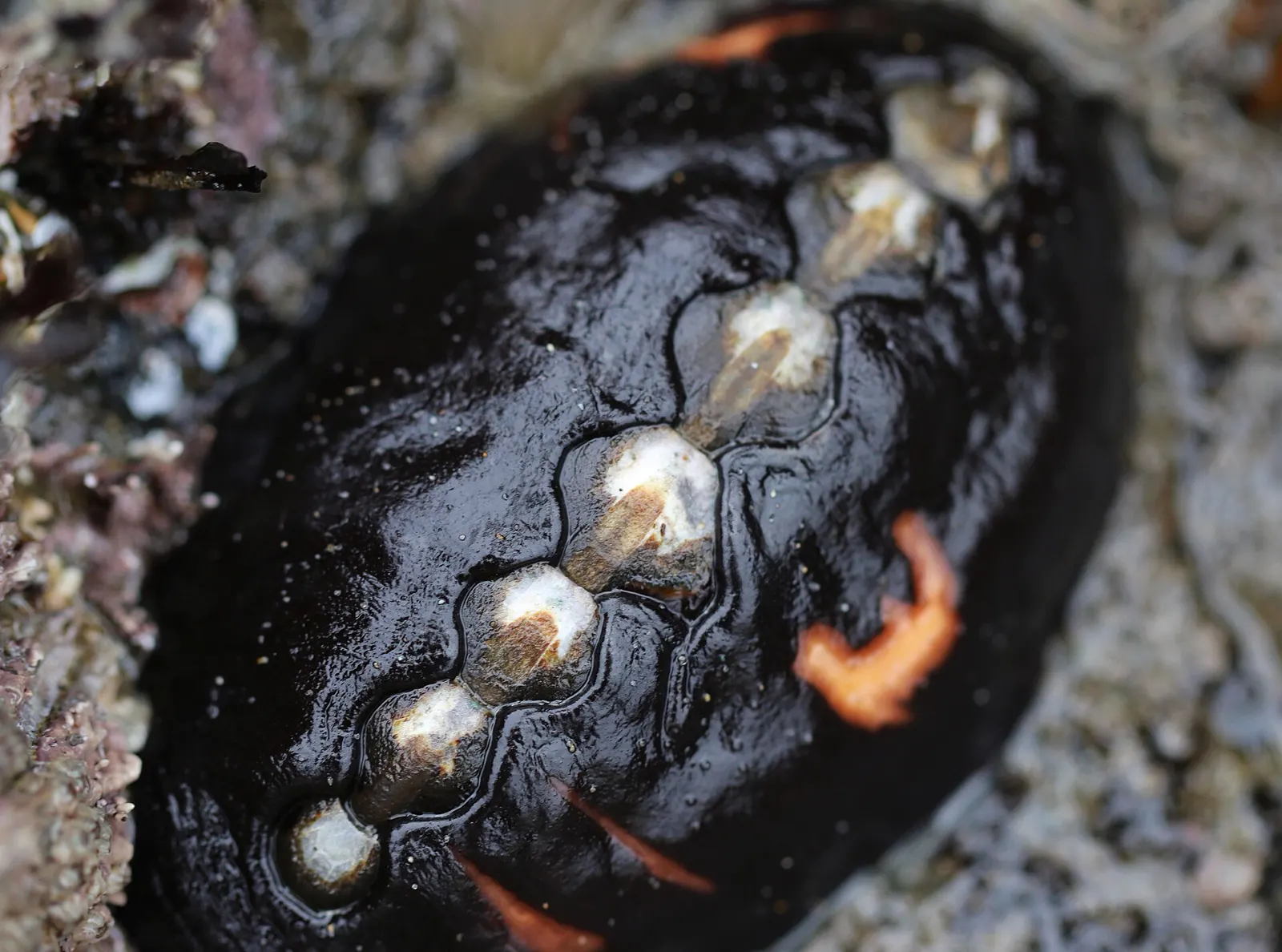
A black katy (black leather) chiton, Katharina tunicata

Animal group

Chitons of the Pacific coast

Scientific group: Class Polyplacophora1

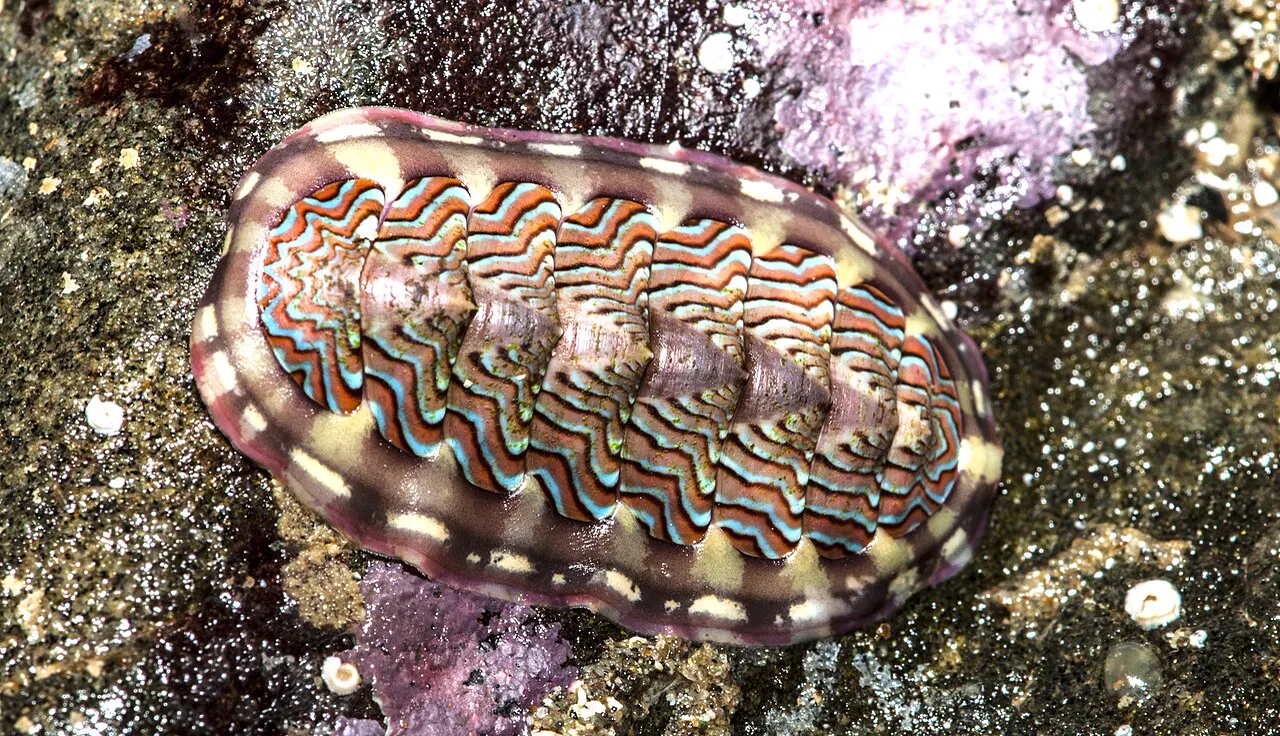
Chitons are oval mollusks with flattened bodies and eight plates along their backs.2 They feed when the tide is high, scraping algae, bacteria and diatoms off the rocks.3

A black katy (black leather) chiton, Katharina tunicata. Location: not recorded. Photo: Peter Pearsall/U.S. Fish and Wildlife Service (USFWS - Pacific Region) (opens in a new tab) · Public domain

Varieties

The main kinds you might see. Each photo is identified as that species in its own record; tap a photo to see it full size.

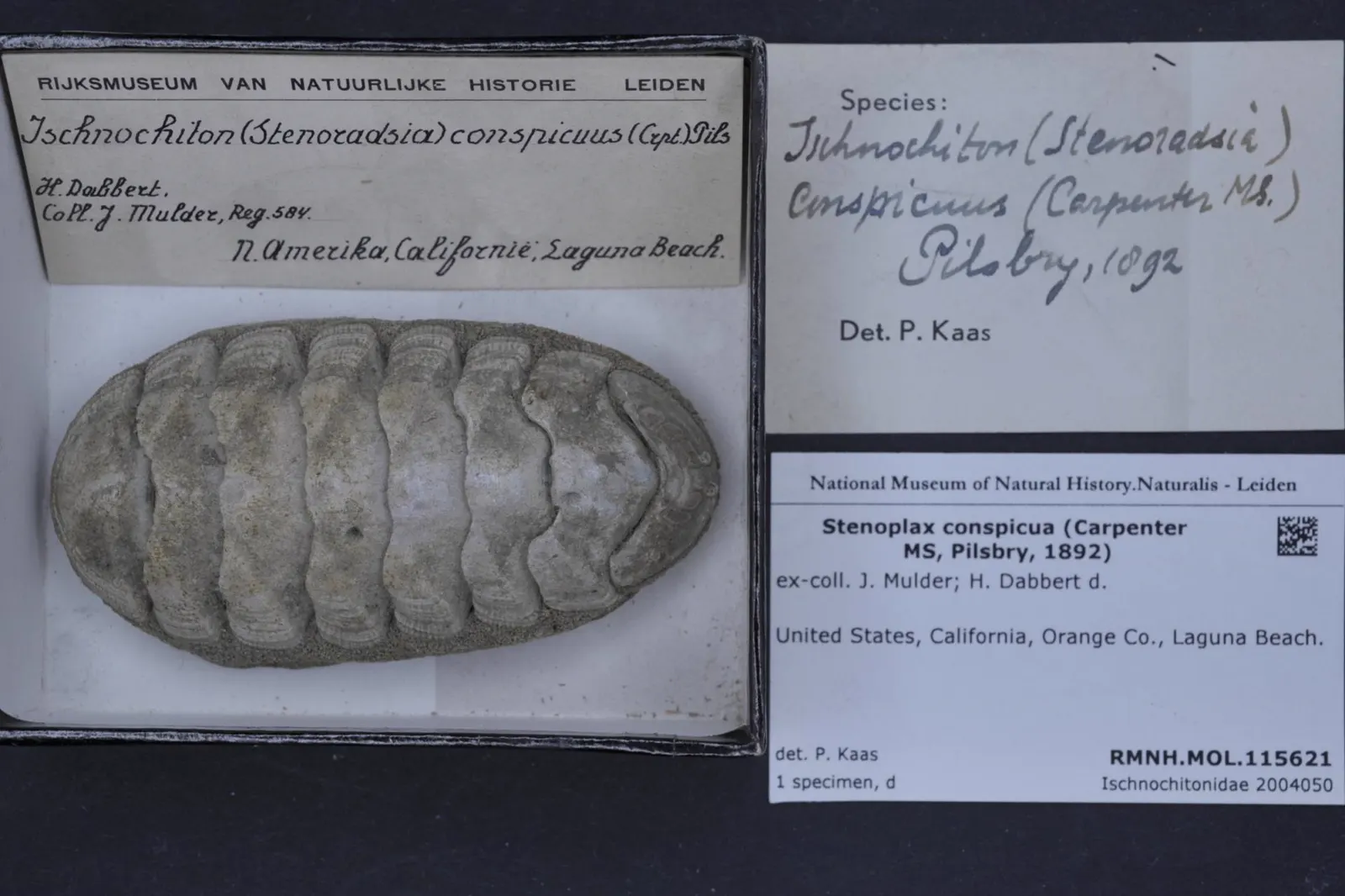
Museum specimen of a conspicuous chiton (Stenoplax conspicua), seen from above

Conspicuous chiton

Stenoplax conspicua4

  • The conspicuous chiton is the largest chiton in Southern California, reaching nearly 4 inches. Its long body is covered on top by scales or plaques.4
  • Conspicuous chitons are active at night and avoid sunlight by hiding under rocks in smooth, sandy areas.4

Learn more: Wikipedia: Stenoplax conspicua (opens in a new tab)

Photo: Carpenter MS, Pilsbry, 1892 (opens in a new tab) · CC0 (opens in a new tab)
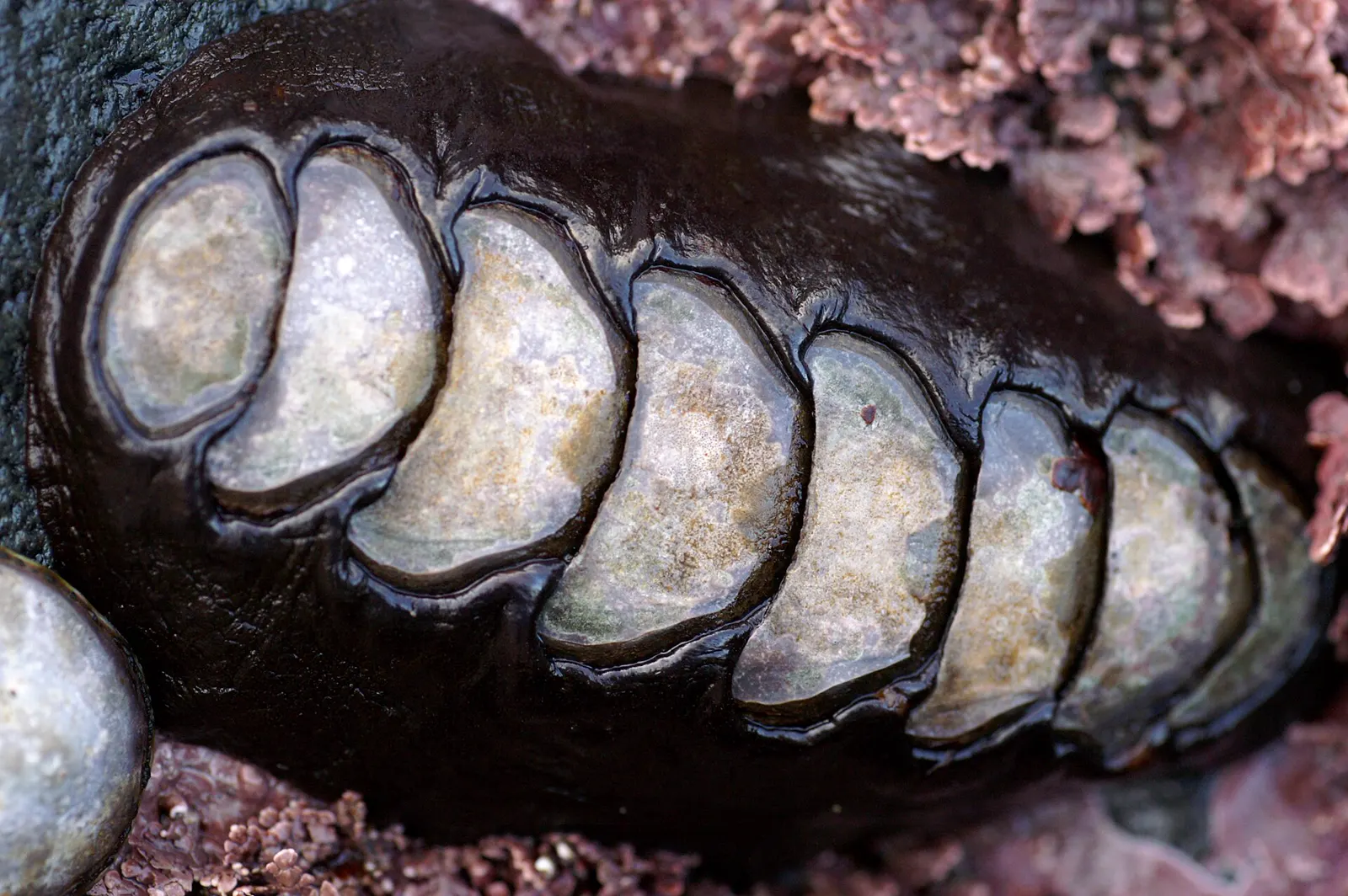
Black katy chiton (Katharina tunicata)

Black katy chiton

Katharina tunicata5

  • The black katy chiton is a slow-moving grazer of many brown and red algae, and of diatoms.5
  • The black katy chiton ranges from Alaska to Point Conception, California, and to Kamchatka, Russia.5

Learn more: Wikipedia: Katharina tunicata (opens in a new tab)

Photo: Minette Layne (opens in a new tab) · CC BY-SA 2.0 (opens in a new tab), resized

What it looks like

  • A chiton's body is a long dome of eight overlapping plates. At Point Reyes, most are about the size of a quarter.1
  • The mossy chiton gets its look from stiff hairs around its edge and the algae that often grow on its shell.3
  • The gumboot chiton is the largest chiton in the world, growing up to 36 cm long.6

Where and when to find it

  • Chitons live in rocky areas from the middle to the low intertidal zone.2
  • In the high zone, which gets only occasional splashes at high tide, look for barnacles, limpets, chitons, crabs and mussels.7

How it lives

  • At low tide, chitons cling to the rocks with their foot.3
  • Like snails, chitons have a tooth-like structure called a radula that scrapes algae off the rocks.8
  • Like pill bugs on land, chitons can roll up to protect themselves from predators.3

How to watch without harming it

  • Don't force chitons, or any other animal attached to a rock, off its surface.7
  • Don't move or turn over rocks. Leave them where and how you found them, to protect the animals living underneath.7
  • Avoid disturbing animals' homes, and touch only with two fingers.4

Range

  • The conspicuous chiton is common on rocks in the middle to low intertidal zone from Santa Barbara to Baja California.8

More photos

A lined chiton (Tonicella lokii) showing its eight colourful plates
A lined chiton (Tonicella lokii) showing its eight colourful plates. Location: not recorded.Photo: Jerry Kirkhart from Los Osos, Calif. (opens in a new tab) · CC BY 2.0 (opens in a new tab), resized

Where the agencies name them

Spots whose managing agency lists chitons for that place.

Further reading

For exploring further. These pages are not sources for the facts above; those are listed under Sources.

Sources

  1. National Park Service, Point Reyes National Seashore: Mollusks (opens in a new tab) · page updated 14 January 2026 · accessed 17 November 2026
  2. National Park Service, Glacier Bay National Park & Preserve: Snails, Limpets & Chitons (opens in a new tab) · page updated 16 March 2018 · accessed 17 November 2026
  3. National Park Service, Channel Islands National Park: Chiton (opens in a new tab) · page updated 21 May 2021 · accessed 17 November 2026
  4. National Park Service, Cabrillo National Monument: Intertidal Field Guide (opens in a new tab) · page updated 25 June 2021 · accessed 17 November 2026
  5. MARINe (Multi-Agency Rocky Intertidal Network), UC Santa Cruz: Katharina (Black Katy Chiton) (opens in a new tab) · page updated 7 August 2025 · accessed 17 November 2026
  6. MARINe (Multi-Agency Rocky Intertidal Network), UC Santa Cruz: Cryptochiton stelleri (Gumboot Chiton) (opens in a new tab) · page updated 9 June 2025 · accessed 17 November 2026
  7. National Park Service: Cabrillo National Monument: The Rocky Intertidal Zone (opens in a new tab) · page updated 31 October 2026 · accessed 17 November 2026
  8. National Park Service, Cabrillo National Monument: Biomodel Library (opens in a new tab) · page updated 22 December 2023 · accessed 17 November 2026

Last checked 17 November 2026 against the sources above.