What it looks like
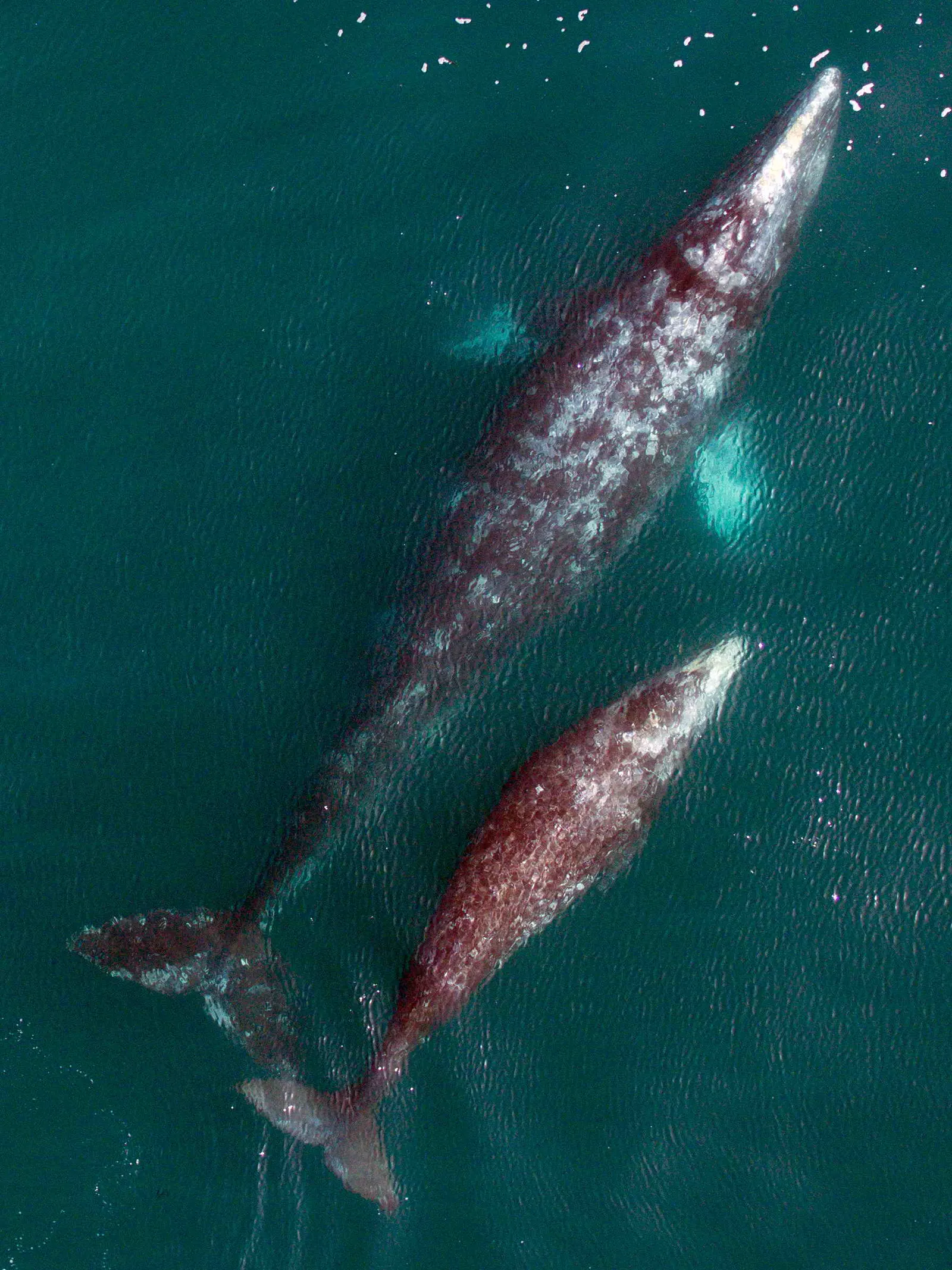
- Gray whales grow to about 49 feet long and about 90,000 pounds.1
- They are mottled gray, with lighter patches.1
- They have no dorsal fin: instead there is a hump followed by a row of small bumps called "knuckles".1
- Barnacles and whale lice cover parts of the body, mostly on the head and tail.1
- From shore, the first sign of a whale is usually its spout, or "blow".3
Where and when to find it
- Gray whales can be seen off Point Loma between December and March.4
- The best shore viewing is from a high point that juts into the ocean, such as Point Dume, the Palos Verdes Peninsula or Point Loma.3
- Early morning, before the wind raises whitecaps, gives the best chance of seeing whales from shore.3
- From mid-February to May, gray whales migrate north along the US West Coast.1
- They live mainly in shallow coastal waters.1
How it lives
- Gray whales feed on the sea floor, eating small animals such as amphipods.1
- They roll on their side and suck up sediment, filtering out food with their baleen plates.1
- Most spend summer feeding in the northern Bering and Chukchi seas.1
- Calves are born from early January to mid-February, during the migration or in the lagoons and bays of Mexico.1
- Newborn calves are about 14 to 16 feet long.1
- They often travel alone or in small groups.1
How to watch without harming it
- Stay at least 100 yards from large whales and limit viewing to 30 minutes or less.1
- Under the Marine Mammal Protection Act, boaters must stay at least 100 yards from whales unless the whale approaches the boat.3
- Do not chase, circle or leapfrog whales with any watercraft.5
- Avoid flying drones near whales; the noise and closeness can harass them.5
- Never feed or try to feed any marine mammal. It is harmful and illegal.5
- Report entangled or stranded whales instead of trying to help them yourself.1
Range
- Gray whales are now regularly found only in the North Pacific, in an eastern population along North America and a western population along eastern Asia.1
Where the agencies name it
Spots whose managing agency lists gray whale for that place.
- Asilomar State Beach tide pools, Pacific Grove
- Bird Rock, Sun Gold Point and False Point tide pools
- Indian Beach tide pools, Ecola State Park
- Haystack Rock tide pools, Cannon Beach
- Hearst San Simeon State Park tide pools, Cambria
- Salt Creek Beach and Strands Beach tide pools
- Sunset Cliffs Natural Park tide pools
Further reading
For exploring further. These pages are not sources for the facts above; those are listed under Sources.
Sources
- NOAA Fisheries: Gray Whale (opens in a new tab) · page updated 21 September 2026 · accessed 17 November 2026
- National Park Service, Cabrillo National Monument: Whale Watching (opens in a new tab) · page updated 28 September 2023 · accessed 17 November 2026
- National Park Service, Channel Islands National Park: Whale Watching (opens in a new tab) · page updated 26 May 2016 · accessed 17 November 2026
- National Park Service, Cabrillo National Monument: Marine Mammals (opens in a new tab) · page updated 30 August 2024 · accessed 17 November 2026
- NOAA Fisheries: Marine Life Viewing Guidelines (opens in a new tab) · accessed 17 November 2026
Last checked 17 November 2026 against the sources above.