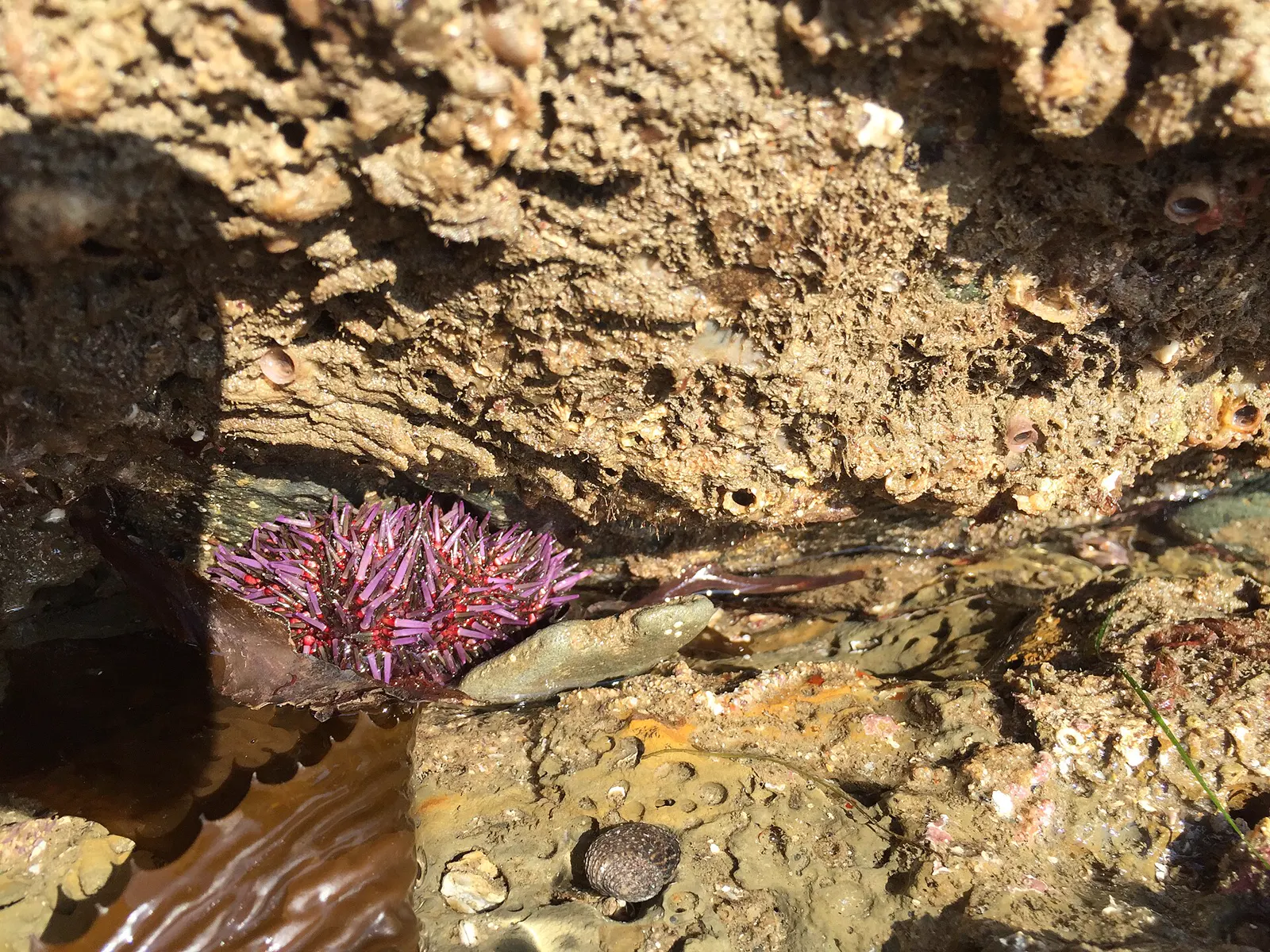
A purple sea urchin tucked under a rock in a tidepool

Animal group

Sea urchins of the Pacific coast

Scientific group: Class Echinoidea (phylum Echinodermata)1

Sea urchins live in tide pools in the lower intertidal zone and are abundant below the tide line.2 Purple sea urchins graze on algae and help control how dense kelp forests become.1

A purple sea urchin tucked under a rock in a tidepool. Location: Cabrillo National Monument, San Diego, California. Photo: NPS Photo (opens in a new tab) · Public domain

Varieties

The main kinds you might see. Each photo is identified as that species in its own record; tap a photo to see it full size.

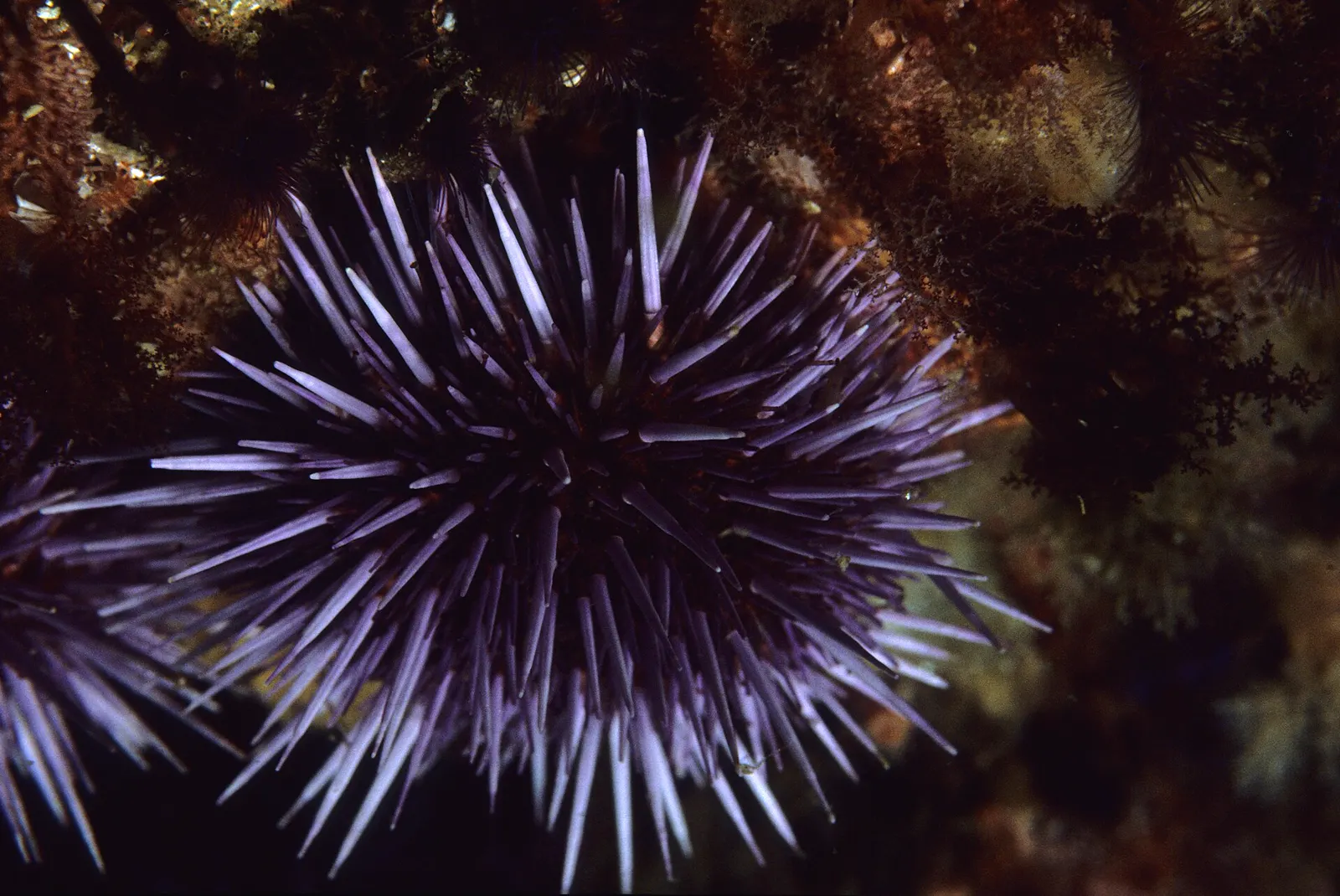
Purple sea urchin (Strongylocentrotus purpuratus)

Purple sea urchin

Strongylocentrotus purpuratus1

  • Purple sea urchins are fairly small, 50 to 100 mm, with bright purple spines; young ones under 30 mm are sometimes pale green.1
  • Purple sea urchins are common in cracks, pools and mussel beds in the middle to low intertidal, and live below the tides to 160 m.1

Learn more: Wikipedia: Strongylocentrotus purpuratus (opens in a new tab)

Photo: Dr. Dwayne Meadows, NOAA/NMFS/OPR. (opens in a new tab) · Public domain
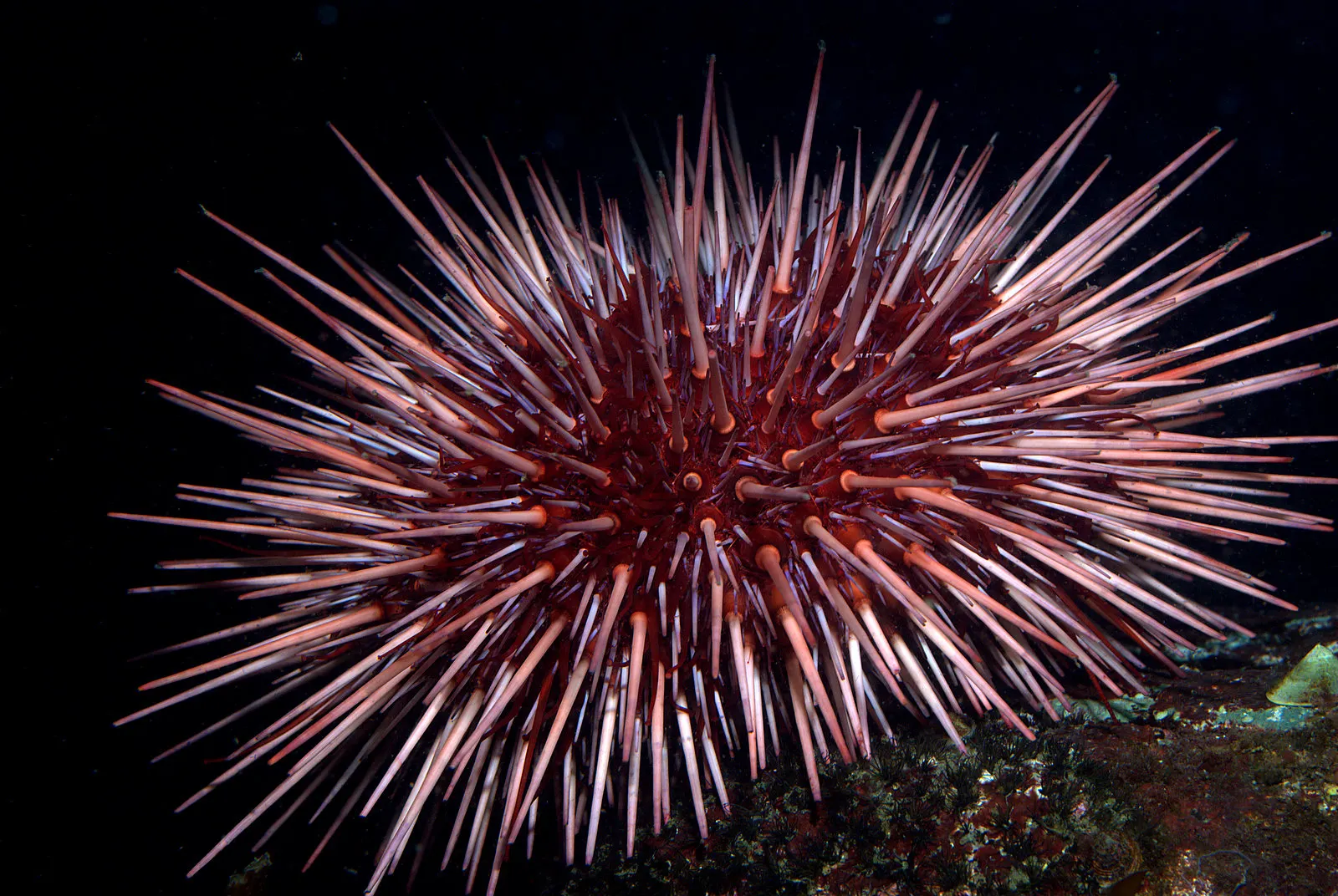
Red sea urchin (Mesocentrotus franciscanus)

Red sea urchin

Mesocentrotus franciscanus1

  • Red sea urchins are usually larger, about 100 mm or more, with long red to dark purple-brown spines.1
  • Red sea urchins mostly live below the tides, to 90 m, but occasionally turn up in the very low intertidal.1

Learn more: Wikipedia: Red sea urchin (opens in a new tab)

Photo: Ed Bierman from CA, usa (opens in a new tab) · CC BY 2.0 (opens in a new tab), resized

What it looks like

  • A sea urchin is encased in a round skeleton of interlocking calcium carbonate plates.1
  • The skeleton is covered with spines, tube feet and small pincers called pedicellariae.1

Where and when to find it

  • The National Park Service lists urchins among the animals of the low zone, which is uncovered only during the lowest tides.3
  • In sedimentary rock, purple urchins often sit in round hollows or pits worn into the rock by urchins.1

How it lives

  • Urchins hold on with their tube feet while they feed, and can move quickly by walking on their feet, spines or teeth.4
  • Purple urchins usually eat drifting bits of kelp, but switch to grazing live seaweed when drift kelp is scarce.1
  • Large groups of urchins can eat through kelp beds and leave "urchin barrens" where seaweed is scarce.2
  • Sea otters eat sea urchins and help keep their numbers in check.2

How to watch without harming it

  • Never pull an urchin off a rock or any other surface.3
  • If you touch a tidepool animal, touch it very gently.3
  • Leave rocks where they are and the way up they were, to protect the animals living underneath.3
  • MARINe accepts reports of disease in purple sea urchins as well as in sea stars.5

Range

  • The purple sea urchin ranges from Alaska to Cedros Island, Mexico.1

Where the agencies name them

Spots whose managing agency lists sea urchins for that place.

Further reading

For exploring further. These pages are not sources for the facts above; those are listed under Sources.

Sources

  1. MARINe (Multi-Agency Rocky Intertidal Network), UC Santa Cruz: Strongylocentrotus purpuratus (Purple Urchin) (opens in a new tab) · page updated 7 August 2025 · accessed 17 November 2026
  2. National Park Service, Point Reyes National Seashore: Echinoderms (opens in a new tab) · page updated 19 September 2022 · accessed 17 November 2026
  3. National Park Service: Cabrillo National Monument: The Rocky Intertidal Zone (opens in a new tab) · page updated 31 October 2026 · accessed 17 November 2026
  4. National Park Service, Klamath Inventory and Monitoring Network: On the Edge: The Curious Lives of Intertidal Organisms and How We Monitor Them (opens in a new tab) · page updated 28 November 2022 · accessed 17 November 2026
  5. MARINe (Multi-Agency Rocky Intertidal Network), UC Santa Cruz: Sea Star Wasting Disease (opens in a new tab) · page updated 6 October 2026 · accessed 17 November 2026

Last checked 17 November 2026 against the sources above.