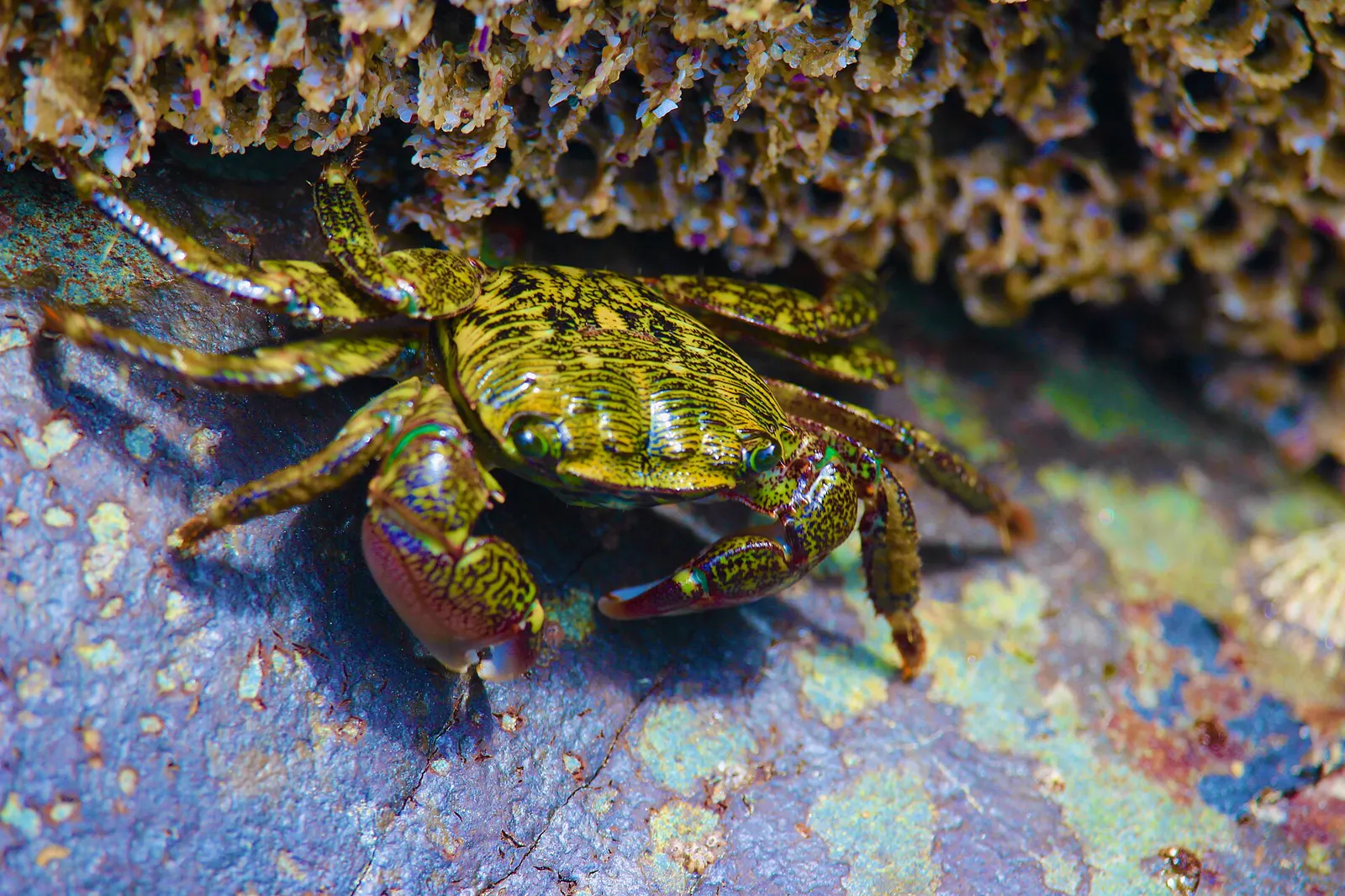
A shore crab (Pachygrapsus crassipes) on rock in front of sandcastle worm tubes

Animal group

Shore crabs of the Pacific coast

Scientific group: True crabs, infraorder Brachyura1

Crabs live even in the high, splash zone of the tidepools, alongside barnacles, limpets, chitons and mussels.2 The shore crab is commonly found in rock crevices in the mid to high intertidal.3

A shore crab (Pachygrapsus crassipes) on rock in front of sandcastle worm tubes. Location: not stated in the photo record (filed under Cabrillo National Monument on Wikimedia Commons and NPGallery). Photo: NPS (opens in a new tab) · Public domain

Varieties

The main kinds you might see. Each photo is identified as that species in its own record; tap a photo to see it full size.

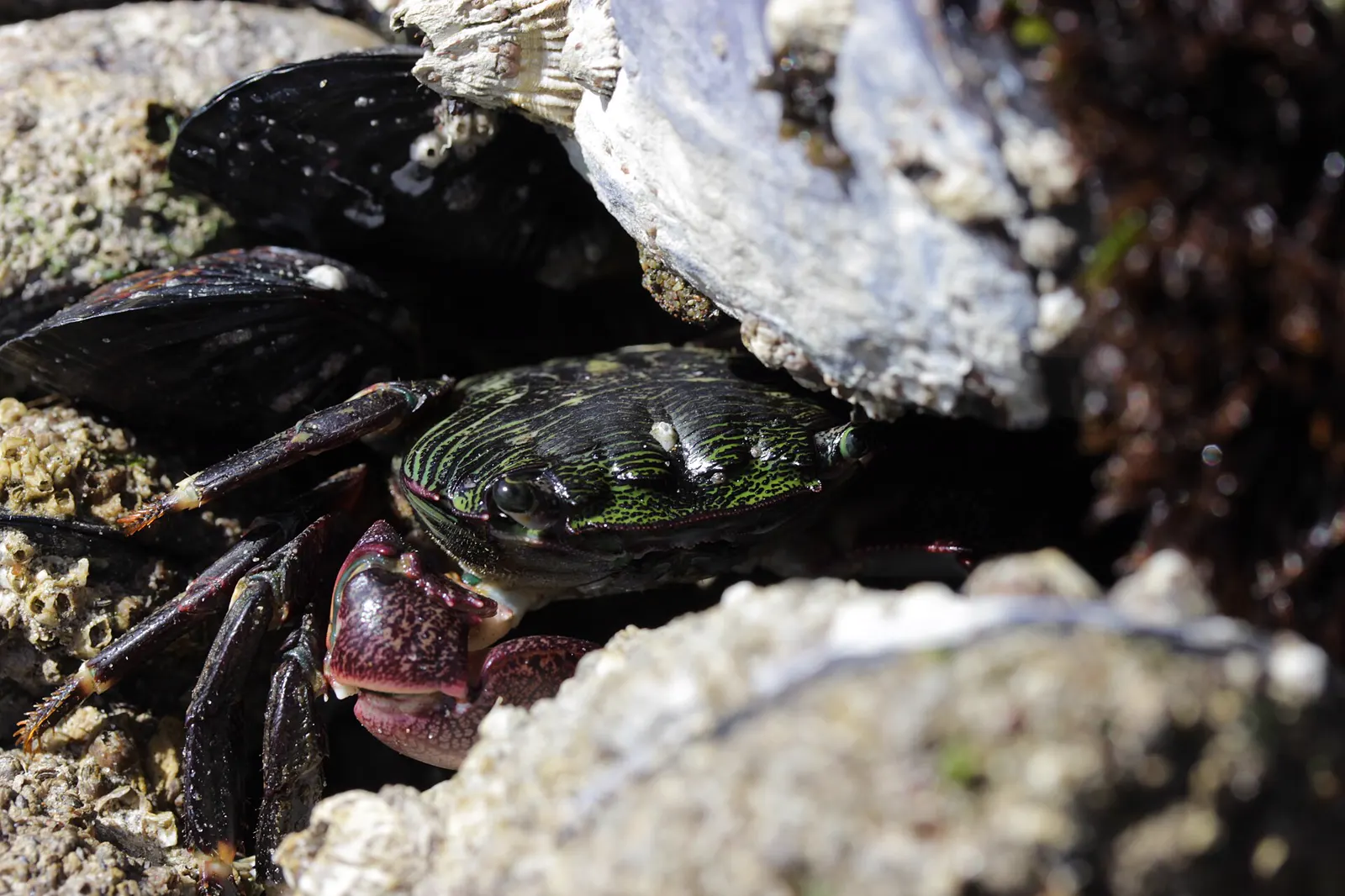
Lined shore crab (Pachygrapsus crassipes)

Lined shore crab

Pachygrapsus crassipes3

  • The shore crab (Pachygrapsus crassipes) has a small, square body about 2 inches wide and is green or red.3
  • The lined shore crab is dark green-black with red or purple on its legs and broken lines across the top of its shell, which is 40-45 mm across.1

Learn more: Wikipedia: Pachygrapsus crassipes (opens in a new tab)

Photo: Björn S... (opens in a new tab) · CC BY-SA 2.0 (opens in a new tab), resized
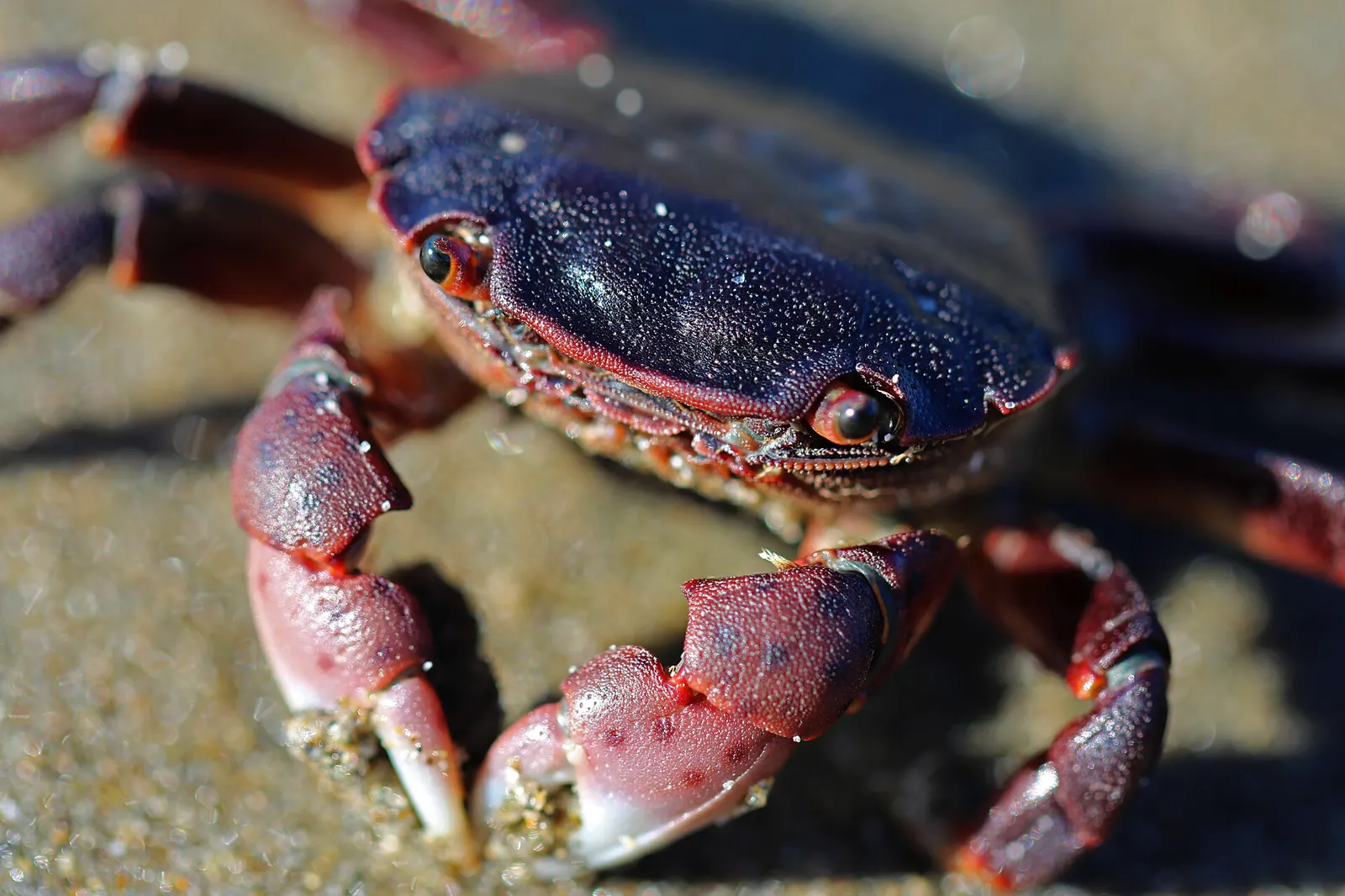
Purple shore crab (Hemigrapsus nudus)

Purple shore crab

Hemigrapsus nudus1

  • The purple shore crab (Hemigrapsus nudus) has a rounded shell without horizontal lines, 35-50 mm across.1
  • The purple shore crab is slower and less aggressive than the lined shore crab. It lives under rocks and among seaweeds in the mid to low intertidal.1

Learn more: Wikipedia: Purple shore crab (opens in a new tab)

Photo: USFWS - Pacific Region (opens in a new tab) · Public domain

What it looks like

  • The globose kelp crab is deep purple to reddish brown and can reach nearly 1 foot across.3

Where and when to find it

  • The lined shore crab is abundant but fast and hard to spot. It lives in the high to mid intertidal on both exposed and sheltered outer coast.1
  • Globose kelp crabs normally live in the kelp forest next to the tidepools, but are sometimes swept into the intertidal.3

How it lives

  • Shore crabs escape predators by moving quickly sideways.3
  • Shore crabs eat plant material and other detritus.3
  • The lined shore crab feeds on films of algae and scavenges.1
  • Romaleon antennarium, a larger crab of the low intertidal and below, preys on hard-shelled animals such as snails and clams.1

How to watch without harming it

  • Don't chase or pick up an animal that is moving away, hiding or resisting being handled.2
  • Don't move or turn over rocks. Leave them where and how you found them to protect the animals living underneath.2
  • If you do pick up an animal to look at it, put it back exactly where you found it. That spot is its home territory.4

Range

  • The lined shore crab ranges from central Oregon to Baja California.1
  • The purple shore crab ranges from Alaska to Baja California, but is uncommon south of Morro Bay.1

Where the agencies name them

Spots whose managing agency lists shore crabs for that place.

Further reading

For exploring further. These pages are not sources for the facts above; those are listed under Sources.

Sources

  1. Stanford University, Hopkins Marine Station (Stanford SeaNet): Crustaceans - crabs, shrimp, isopods, amphipods (opens in a new tab) · accessed 17 November 2026
  2. National Park Service: Cabrillo National Monument: The Rocky Intertidal Zone (opens in a new tab) · page updated 31 October 2026 · accessed 17 November 2026
  3. National Park Service, Cabrillo National Monument: Intertidal Field Guide (opens in a new tab) · page updated 25 June 2021 · accessed 17 November 2026
  4. National Park Service, Channel Islands National Park: Tidepooling (opens in a new tab) · page updated 26 May 2016 · accessed 17 November 2026

Last checked 17 November 2026 against the sources above.