What it looks like
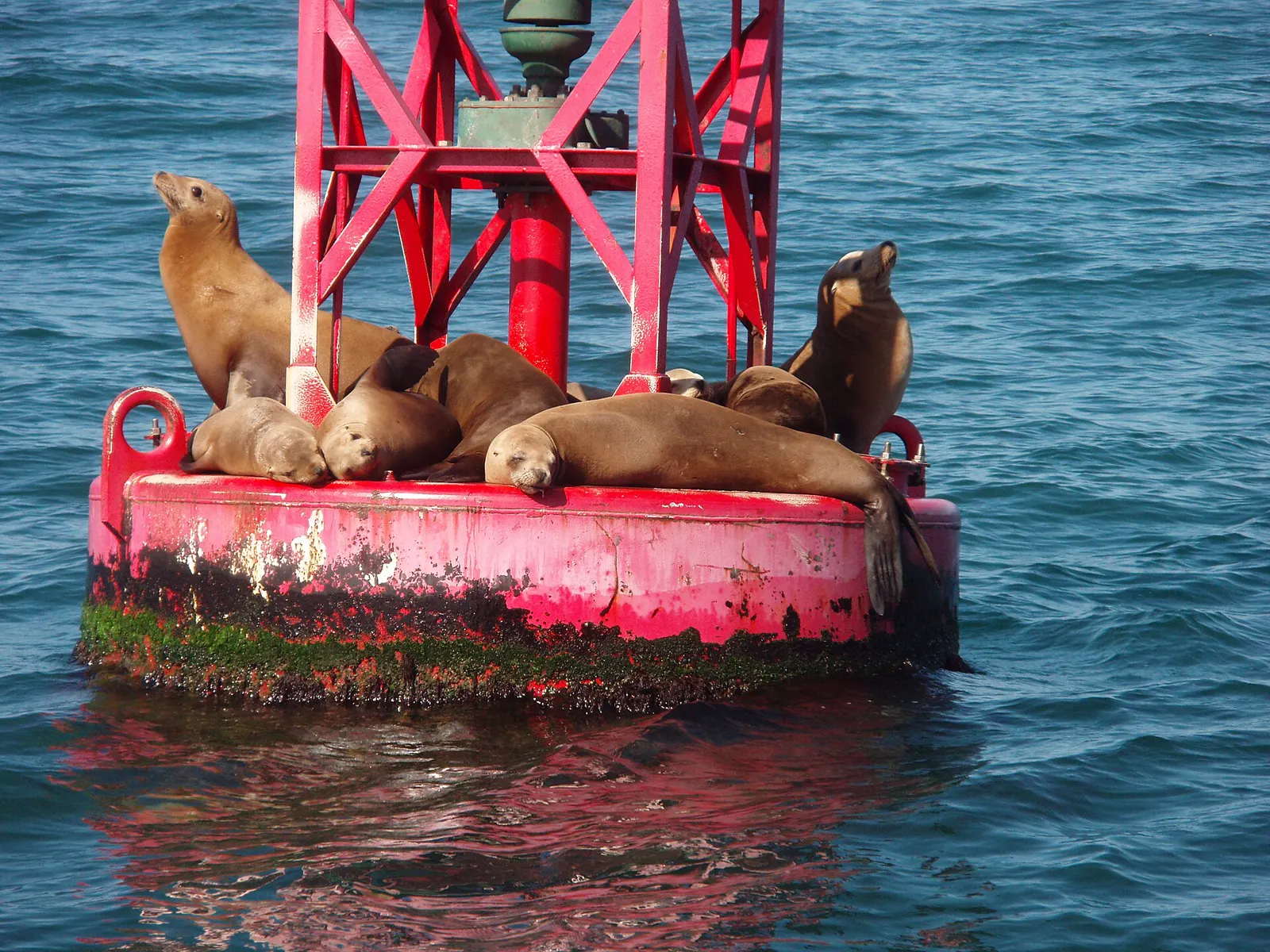
- Adult females and young sea lions are slim and blonde to tan.1
- Adult males are usually bigger than females and dark brown to black.1
- Older males have a raised crest on the forehead, often topped with lighter hair.1
- They have visible ear flaps.1
- Females weigh about 240 pounds and males up to about 700 pounds.1
Where and when to find it
- Seals and sea lions can often be seen from the cliffs at Cabrillo National Monument on Point Loma.2
- There, look for them resting on rock ledges or feeding around the shallow tidepools.2
- Along the West Coast they also haul out on marina docks, jetties and buoys.1
- A sea lion floating still with its flippers held up is usually "rafting": resting and controlling its body heat, not caught in a net.1
How it lives
- They feed mostly offshore, on prey such as squid, anchovies, mackerel, rockfish and sardines.1
- Most pups are born in May and June.1
- A mother leaves her pup ashore while she feeds at sea.1
- If you see a pup alone on the shore, leave it be. If it looks to be in distress, call the local marine mammal stranding network.1
- A mother finds her own pup among hundreds of others by its call.1
How to watch without harming it
- Stay at least 50 yards (half a football field) from seals and sea lions, in the water or on shore. This includes pets.3
- You are too close if an animal starts to stare, fidget or flee into the water.3
- Keep dogs on a leash around seals and sea lions.3
- Never feed a sea lion. It is harmful and illegal.3
- Limit your viewing time to 30 minutes or less.1
- Do not take selfies with marine mammals; it can count as harassment, which is illegal.3
- Don't try to help a sick or tangled animal yourself; report it to trained responders.1
Range
- California sea lions range from southeast Alaska to the Pacific coast of central Mexico, and breed mainly from the Channel Islands south to central Mexico.1
Where the agencies name them
Spots whose managing agency lists sea lions for that place.
- Asilomar State Beach tide pools, Pacific Grove
- Bird Rock, Sun Gold Point and False Point tide pools
- Crystal Cove State Park tidepools
- Little Corona del Mar tide pools
- Main Beach tide pools, Laguna Beach
- Point Lobos State Natural Reserve tide pools, Carmel
- Salt Creek Beach and Strands Beach tide pools
- Seal Rock tide pools, Oregon
- Shaw's Cove tide pools
- Treasure Island tide pools, Laguna Beach
Further reading
For exploring further. These pages are not sources for the facts above; those are listed under Sources.
Sources
- NOAA Fisheries: California Sea Lion (opens in a new tab) · page updated 7 April 2025 · accessed 17 November 2026
- National Park Service, Cabrillo National Monument: Marine Mammals (opens in a new tab) · page updated 30 August 2024 · accessed 17 November 2026
- NOAA Fisheries: Marine Life Viewing Guidelines (opens in a new tab) · accessed 17 November 2026
Last checked 17 November 2026 against the sources above.