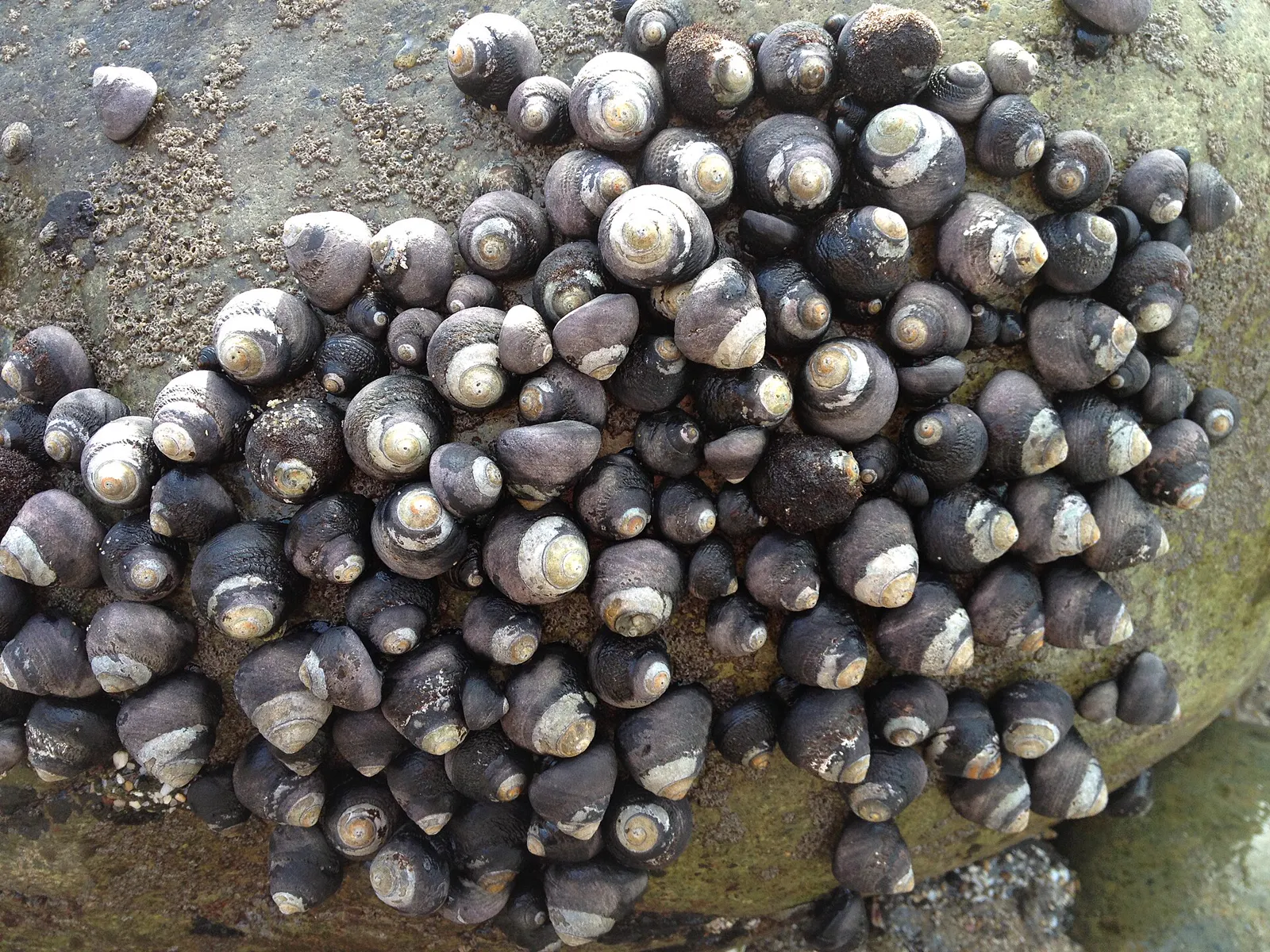
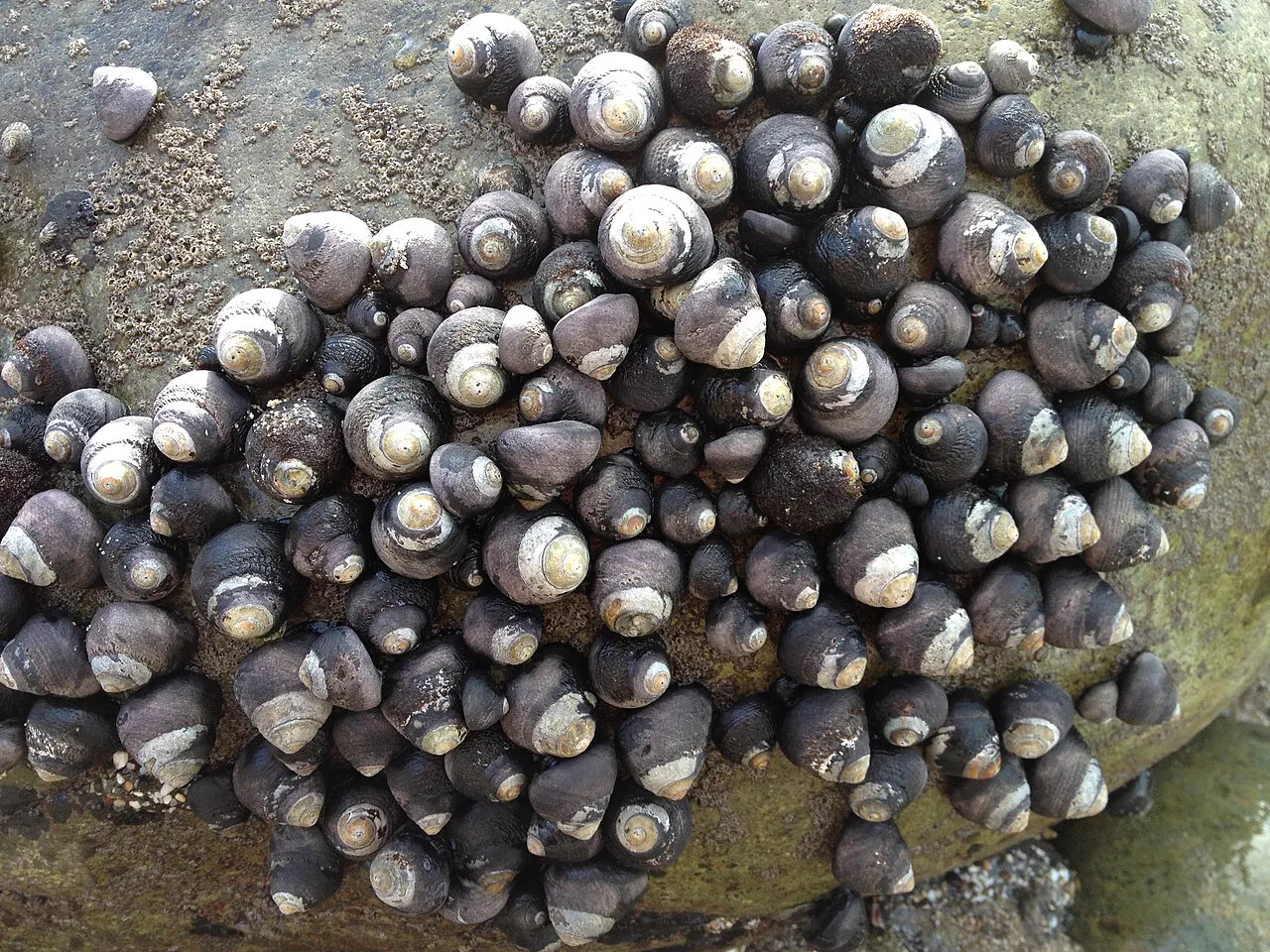
A group of black turban (black tegula) snails

Animal group

Tidepool snails of the Pacific coast

Scientific group: Class Gastropoda1

Snails are abundant in the intertidal zone. Common kinds include black and brown turban snails and periwinkles.2 Most graze on algae, scraping it off the rock with a rough, tongue-like radula.2

A group of black turban (black tegula) snails. Location: Cabrillo National Monument, San Diego County, California. Photo: NPS Photo (opens in a new tab) · Public domain

Varieties

The main kinds you might see. Each photo is identified as that species in its own record; tap a photo to see it full size.

A group of black turban (black tegula) snails

Black turban snail

Tegula funebralis3

  • Black turban snails are 1 to 1.5 inches tall and deep purple-black.3
  • The black turban snail's spiral shell is black, spiralling up to an iridescent centre.4

Learn more: Wikipedia: Tegula funebralis (opens in a new tab)

Photo: NPS Photo (opens in a new tab) · Public domain
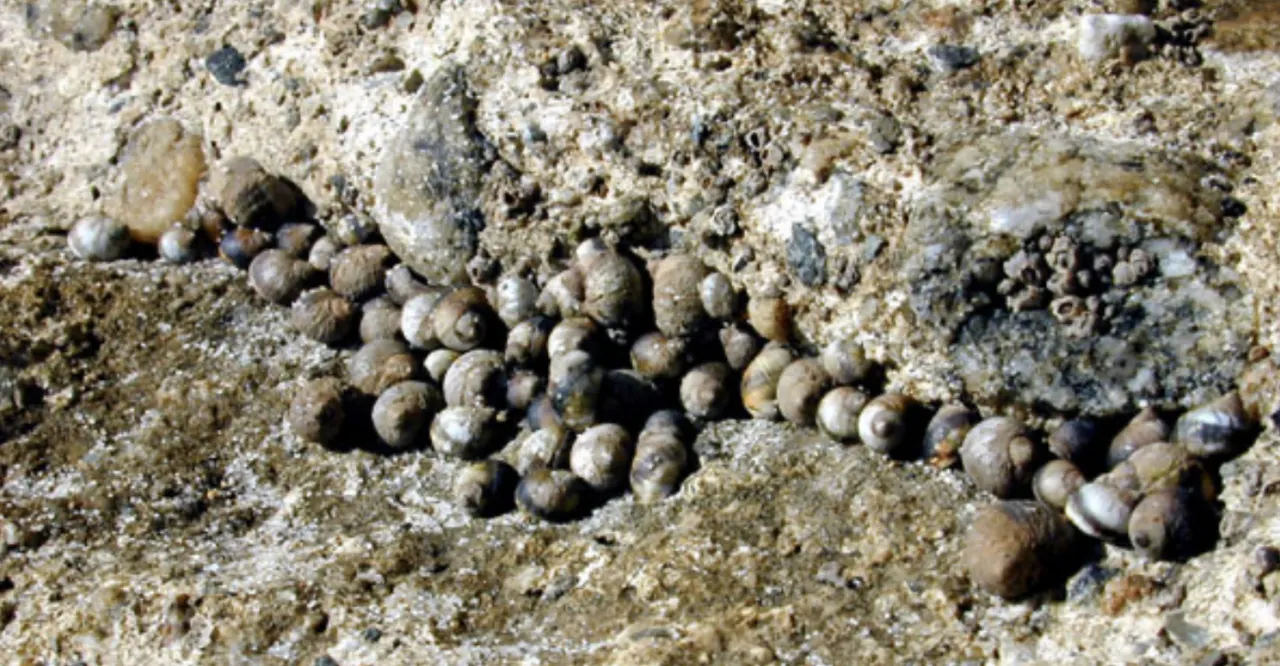
A cluster of small periwinkle snails in a rock depression in the high zone

Periwinkles

Littorina5

  • Periwinkles have a spiral pattern on the shell, like their land relative, the garden snail.4
  • Periwinkles live in the highest intertidal zone and extend down into the upper part of the middle zone.5

Learn more: Wikipedia: Littorina (opens in a new tab)

Photo: NPS (opens in a new tab) · Public domain

What it looks like

  • One larger turban snail of the middle and low zones has a heavy, sculpted shell, often camouflaged by algae growing on it.6

Where and when to find it

  • Black turban snails live in the high and middle intertidal zones, often clustered in crevices or on the sides of rocks.3
  • At low tide, some snails tuck themselves tightly into crevices.2

How it lives

  • Black turban snails feed on microscopic algae and seaweeds. Their empty shells are a favourite home for hermit crabs.3
  • Snails can pull back into their shells behind a trapdoor-like plate called an operculum, which protects them from predators and drying out.2
  • Periwinkles spend more time out of the water than in it, and may drown if kept underwater too long.5
  • Not all snails graze: dogwinkles eat mussels and barnacles by drilling a small hole in the shell with the radula.5

How to watch without harming it

  • Look twice at a shell: it may hold a snail, or a hermit crab may have moved in.4
  • Don't chase or pick up animals that are moving away, hiding or resisting handling.7
  • At Cabrillo National Monument, collecting anything, living or dead, including shells, is forbidden.7

Range

  • Periwinkles are found in the intertidal zone worldwide.4
  • The larger turban snail described by Cabrillo National Monument lives in the middle, low and subtidal zones from Point Conception to Baja California.6

More photos

A cluster of small periwinkle snails in a rock depression in the high zone
A cluster of small periwinkle snails in a rock depression in the high zone. Location: Cabrillo National Monument, San Diego County, California.Photo: NPS (opens in a new tab) · Public domain

Where the agencies name them

Spots whose managing agency lists tidepool snails for that place.

Further reading

For exploring further. These pages are not sources for the facts above; those are listed under Sources.

Sources

  1. National Park Service, Point Reyes National Seashore: Mollusks (opens in a new tab) · page updated 14 January 2026 · accessed 17 November 2026
  2. National Park Service, Channel Islands National Park: Snails (opens in a new tab) · page updated 21 May 2021 · accessed 17 November 2026
  3. National Park Service, Cabrillo National Monument: Intertidal Field Guide (opens in a new tab) · page updated 25 June 2021 · accessed 17 November 2026
  4. National Park Service, Point Reyes National Seashore: Tidepooling at Point Reyes National Seashore (opens in a new tab) · page updated 19 March 2023 · accessed 17 November 2026
  5. National Park Service, Glacier Bay National Park & Preserve: Snails, Limpets & Chitons (opens in a new tab) · page updated 16 March 2018 · accessed 17 November 2026
  6. National Park Service, Cabrillo National Monument: Biomodel Library (opens in a new tab) · page updated 22 December 2023 · accessed 17 November 2026
  7. National Park Service: Cabrillo National Monument: The Rocky Intertidal Zone (opens in a new tab) · page updated 31 October 2026 · accessed 17 November 2026

Last checked 17 November 2026 against the sources above.