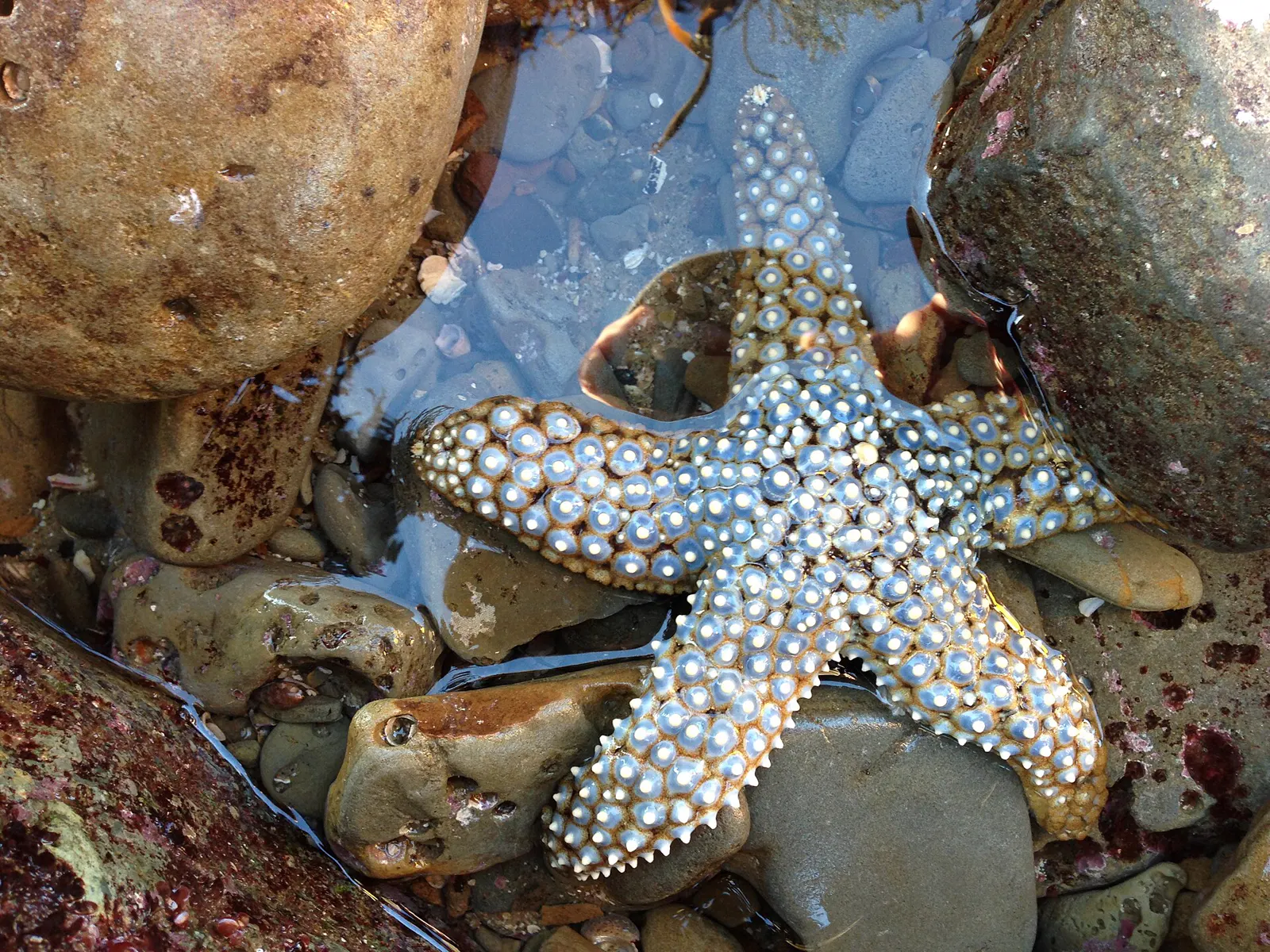
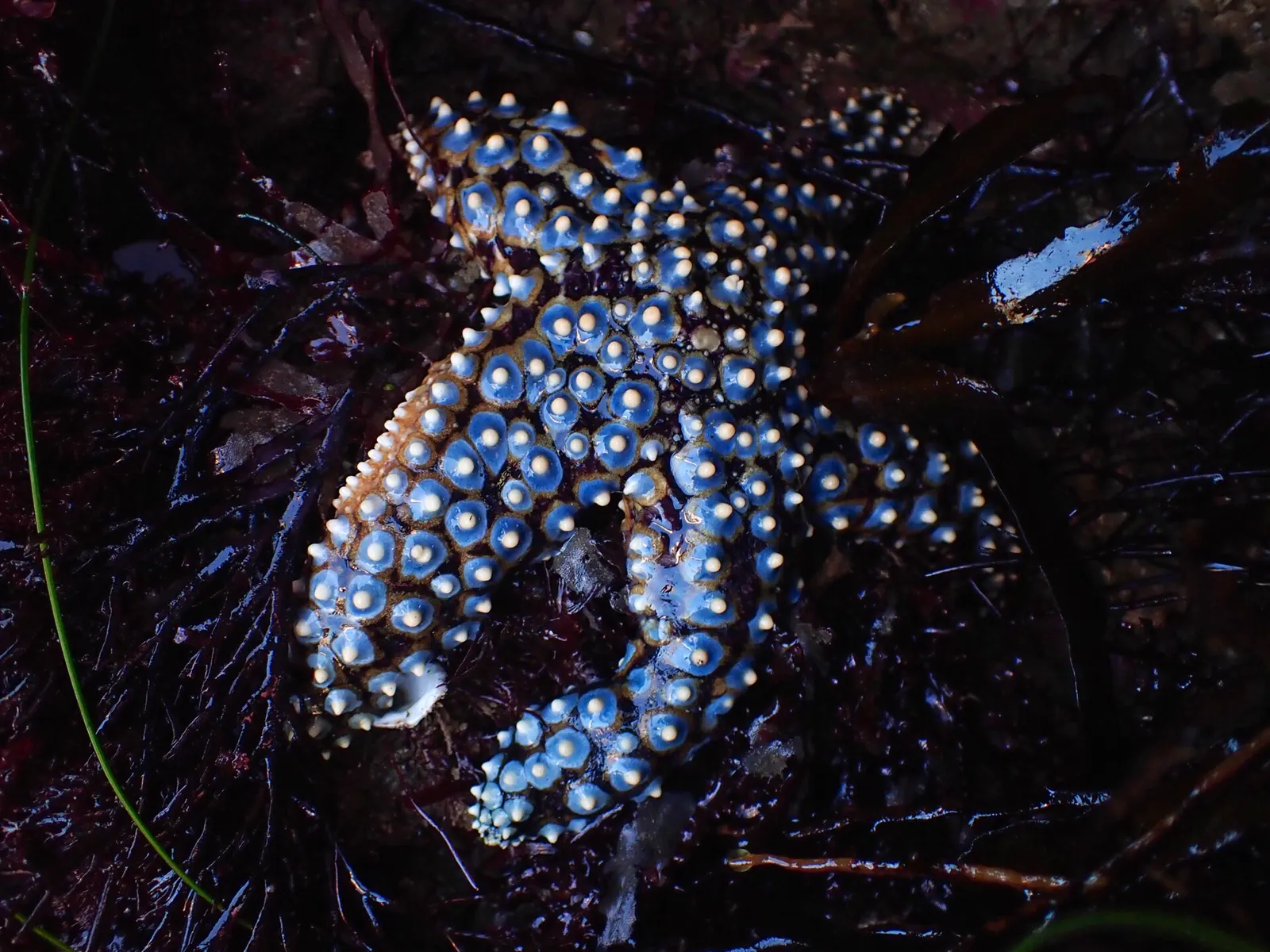
A knobby sea star (Pisaster giganteus) on rock in a tidepool, with white knobby spines on its five arms

Animal group

Sea stars of the Pacific coast

Scientific group: Echinoderms (the group that also includes sea urchins, sand dollars and sea cucumbers)1

Sea stars are sturdy, flexible predators of the rocky intertidal zone.2 Some species, such as the ochre sea star, play an especially important role in the rocky shore community.3 A wasting disease killed huge numbers of sea stars along the Pacific coast of North America in 2013 and 2014.4

A knobby sea star (Pisaster giganteus) on rock in a tidepool, with white knobby spines on its five arms. Location: Cabrillo National Monument, San Diego, California. Photo: NPS Photo (opens in a new tab) · Public domain

Varieties

The main kinds you might see. Each photo is identified as that species in its own record; tap a photo to see it full size.

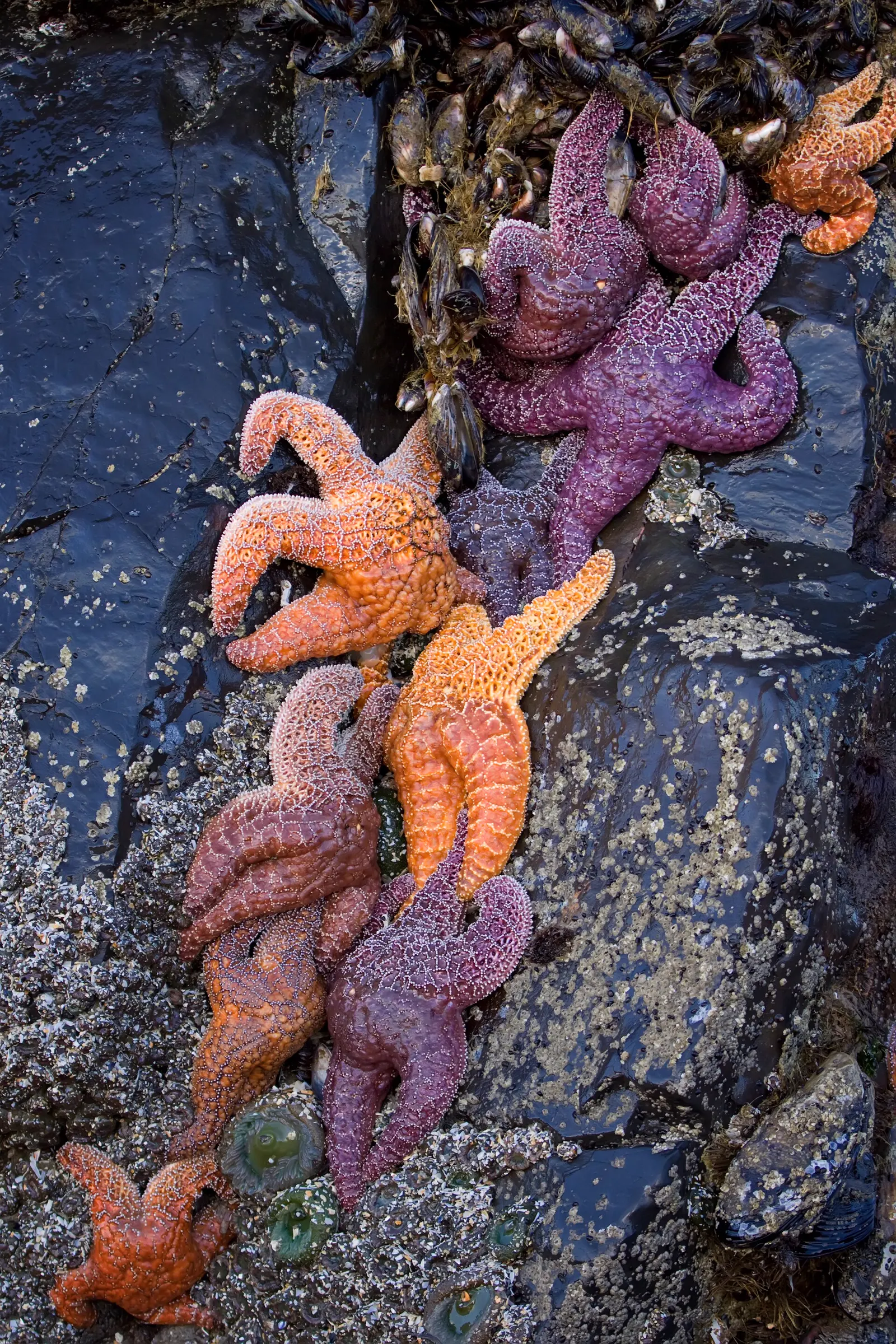
Ochre sea star (Pisaster ochraceus)

Ochre sea star

Pisaster ochraceus3

  • The ochre sea star varies in colour. It is most often purple, but can be orange, yellow, reddish or brown.5
  • The ochre sea star is common in the middle to low intertidal on wave-swept rocky shores, and also lives below the tide line to 90 m deep.5

Learn more: Wikipedia: Pisaster ochraceus (opens in a new tab)

Photo: Steven Pavlov (opens in a new tab) · CC BY-SA 4.0 (opens in a new tab), resized
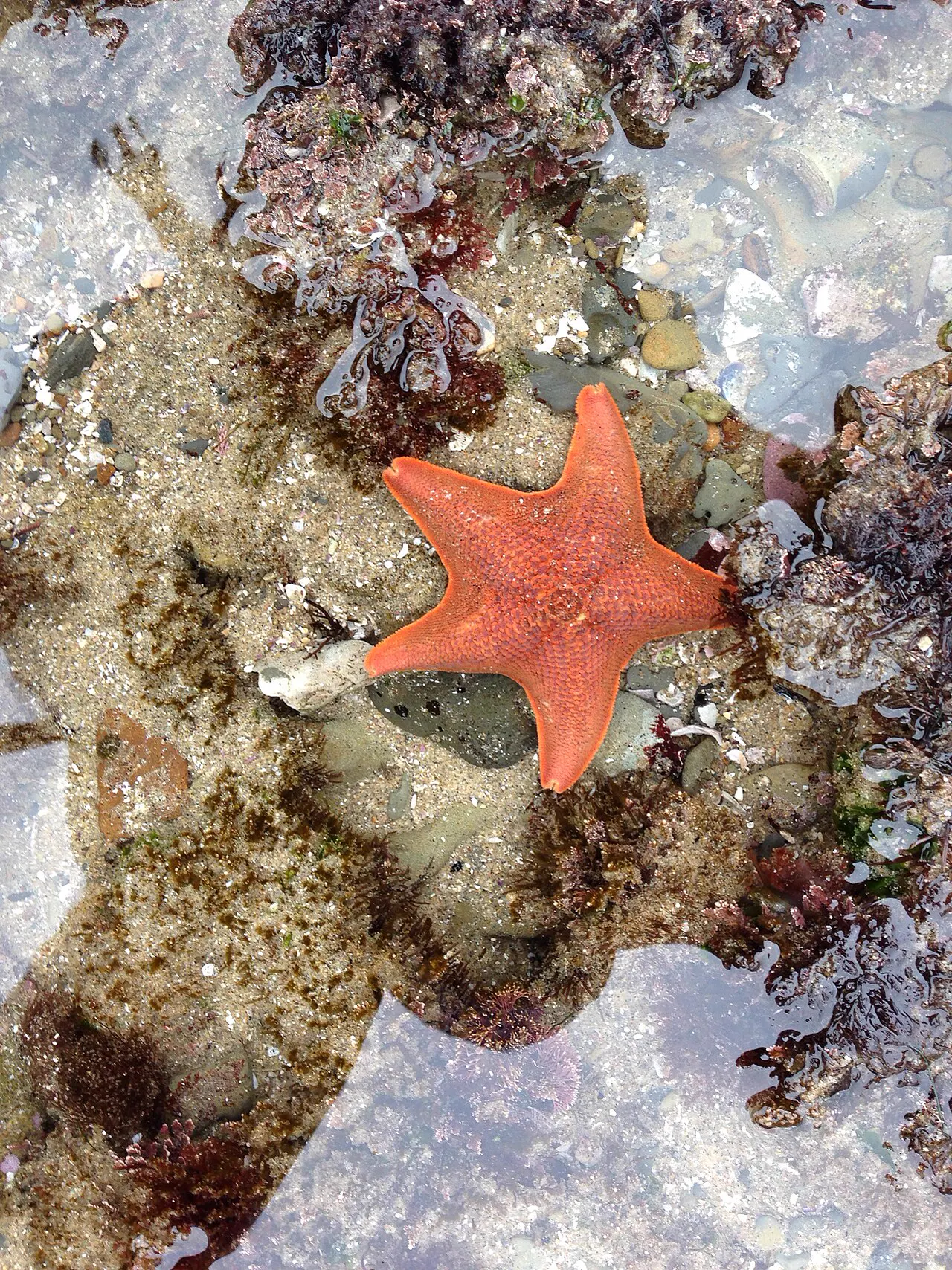
Bat star (Patiria miniata)

Bat star

Patiria miniata6

  • Bat stars have webbing between their five arms, which other sea stars lack.6
  • Bat stars in tidepools are mostly small, 1 to 3 inches across, and are found under rocks or in sandy areas.6

Learn more: Wikipedia: Patiria miniata (opens in a new tab)

Photo: Dr. Dwayne Meadows, NOAA/NMFS/OPR. (opens in a new tab) · Public domain

What it looks like

  • Sea stars have a skeleton of bony plates and strong tube feet for clinging to rock and moving around.7
  • Not every sea star has five arms; some species have 10, 20 or even 40.1

Where and when to find it

  • The National Park Service lists sea stars among the animals of the low zone, which is uncovered only during the lowest tides.8
  • Young ochre sea stars stay hidden in crevices, under rocks and inside mussel beds.5

How it lives

  • Sea stars eat urchins by wrapping their arms around them, pushing their stomach out of their body and digesting the prey outside the body.6
  • Ochre sea stars keep a mix of species on the shore by eating California mussels, which would otherwise quickly cover the rocks.3
  • Ochre sea stars can regrow lost arms and are thought to live up to 20 years.5
  • Ochre sea stars release eggs and sperm into the water, and their young begin life as free-swimming larvae.5

How to watch without harming it

  • Never pull a sea star off a rock or any other surface.8
  • If you touch a tidepool animal, touch it very gently.8
  • Leave rocks where they are and the way up they were, to protect the animals living underneath.8
  • MARINe asks people who record sea star observations to log them even when they find only healthy sea stars, or none.4

Range

  • The ochre sea star ranges from Prince William Sound in Alaska to Baja California, Mexico.5

More photos

An orange bat star (Patiria miniata) with five arms on tidepool rocks
An orange bat star (Patiria miniata) with five arms on tidepool rocks. Location: Cabrillo National Monument, San Diego, California.Photo: NPS Photo (opens in a new tab) · Public domain

Where the agencies name them

Spots whose managing agency lists sea stars for that place.

Further reading

For exploring further. These pages are not sources for the facts above; those are listed under Sources.

Sources

  1. NOAA National Ocean Service: Are starfish really fish? (opens in a new tab) · page updated 23 September 2026 · accessed 17 November 2026
  2. National Park Service, Point Reyes National Seashore: Echinoderms (opens in a new tab) · page updated 19 September 2022 · accessed 17 November 2026
  3. National Park Service, Redwood National and State Parks: Sea Stars (opens in a new tab) · page updated 7 December 2020 · accessed 17 November 2026
  4. MARINe (Multi-Agency Rocky Intertidal Network), UC Santa Cruz: Sea Star Wasting Disease (opens in a new tab) · page updated 6 October 2026 · accessed 17 November 2026
  5. MARINe (Multi-Agency Rocky Intertidal Network), UC Santa Cruz: Pisaster ochraceus (Ochre Star) (opens in a new tab) · page updated 7 October 2026 · accessed 17 November 2026
  6. National Park Service, Cabrillo National Monument: Intertidal Field Guide (opens in a new tab) · page updated 25 June 2021 · accessed 17 November 2026
  7. National Park Service, Klamath Inventory and Monitoring Network: On the Edge: The Curious Lives of Intertidal Organisms and How We Monitor Them (opens in a new tab) · page updated 28 November 2022 · accessed 17 November 2026
  8. National Park Service: Cabrillo National Monument: The Rocky Intertidal Zone (opens in a new tab) · page updated 31 October 2026 · accessed 17 November 2026

Last checked 17 November 2026 against the sources above.