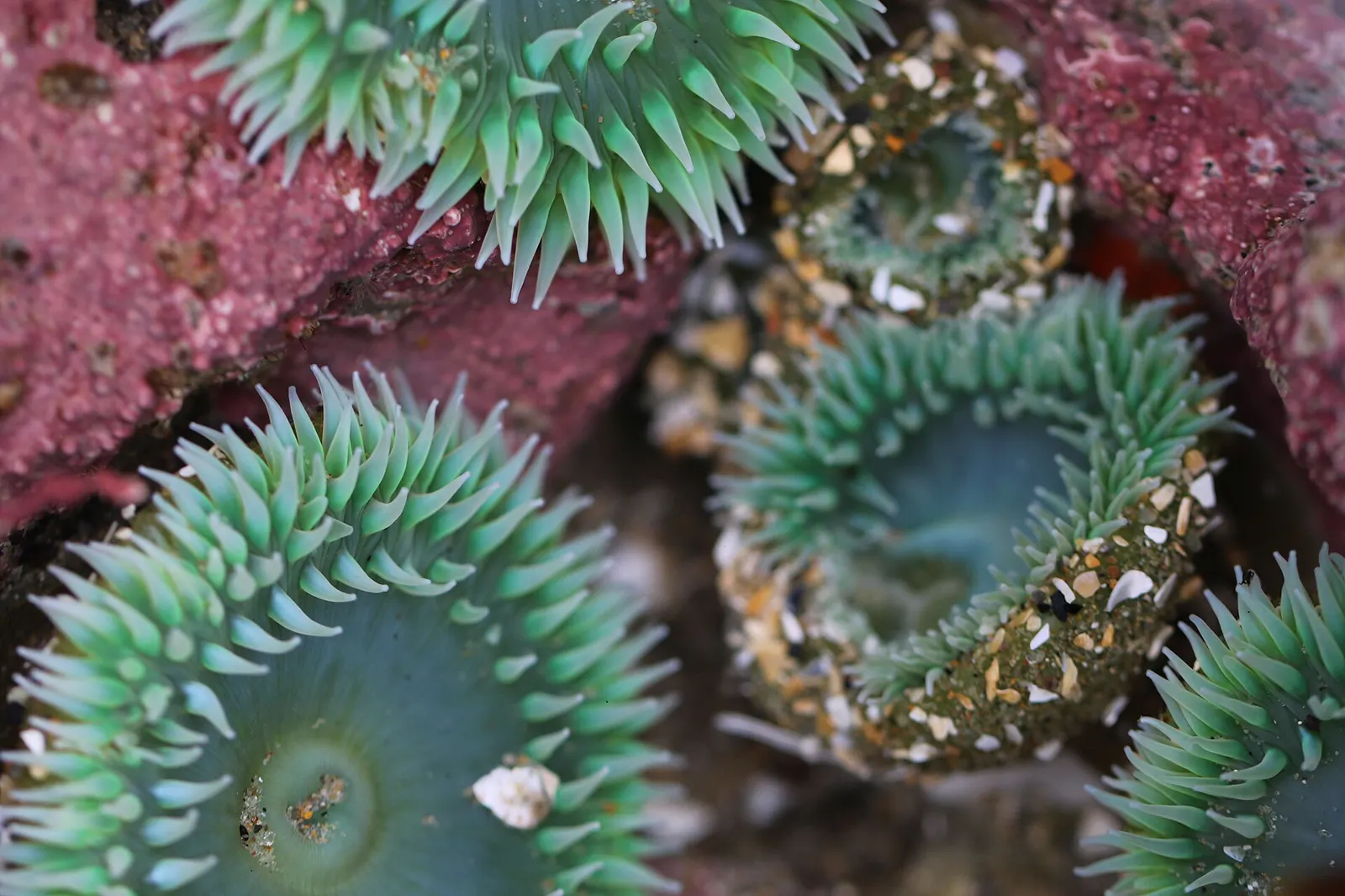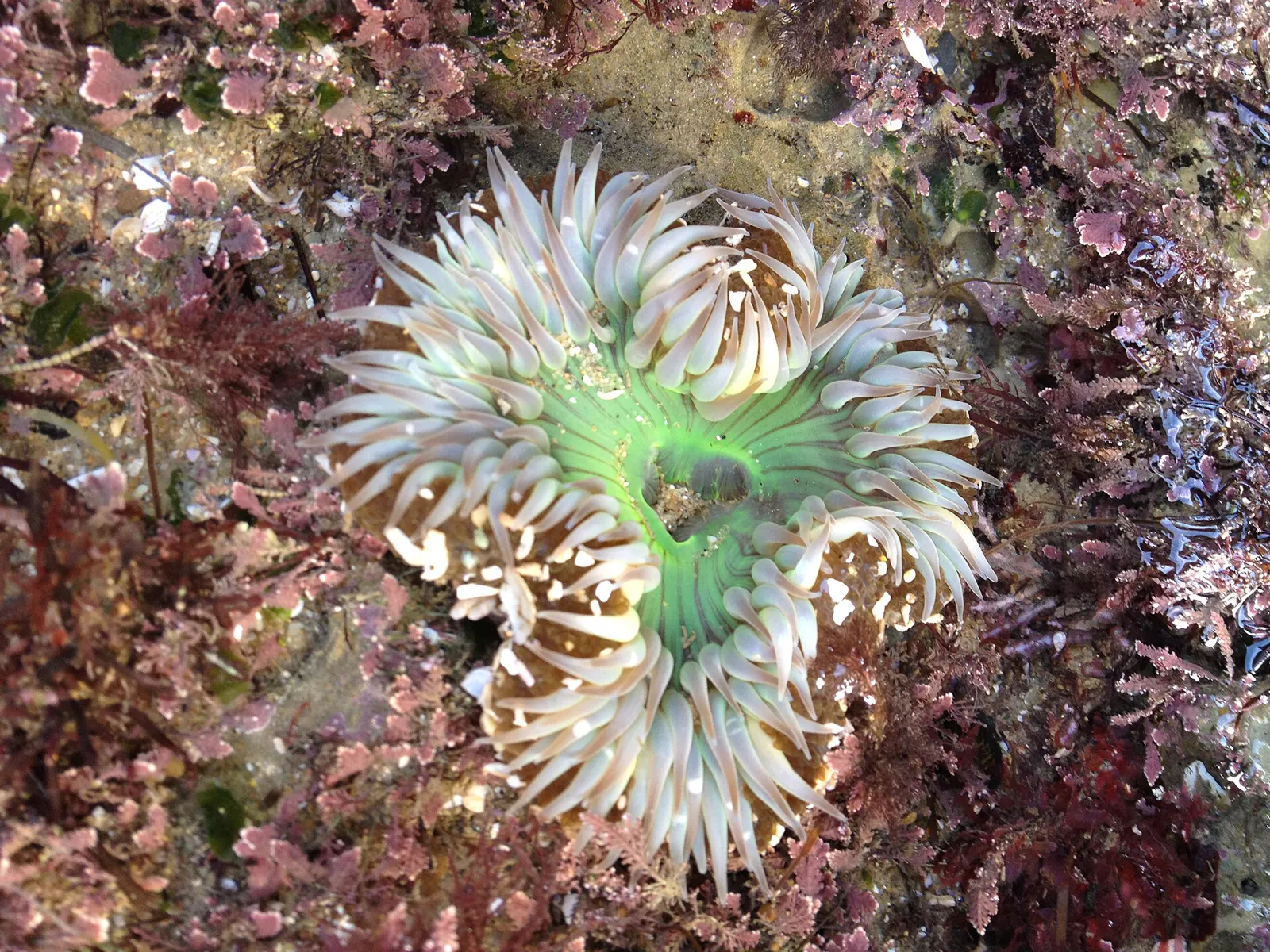
A solitary anemone (Anthopleura sola) seen from above: a round green oral disc ringed by white-tipped tentacles

Animal group

Sea anemones of the Pacific coast

Scientific group: Order Actiniaria (phylum Cnidaria, class Anthozoa)1

The giant green anemone and the slightly smaller aggregating anemone are both common in tidepools.2 Anemones have no hard shell. Their soft, flexible bodies bend with the moving water.3 They catch prey with stinging cells called nematocysts.4

A solitary anemone (Anthopleura sola) seen from above: a round green oral disc ringed by white-tipped tentacles. Location: Cabrillo National Monument, San Diego, California; no GPS recorded. Photo: NPS Photo (opens in a new tab) · Public domain

Varieties

The main kinds you might see. Each photo is identified as that species in its own record; tap a photo to see it full size.

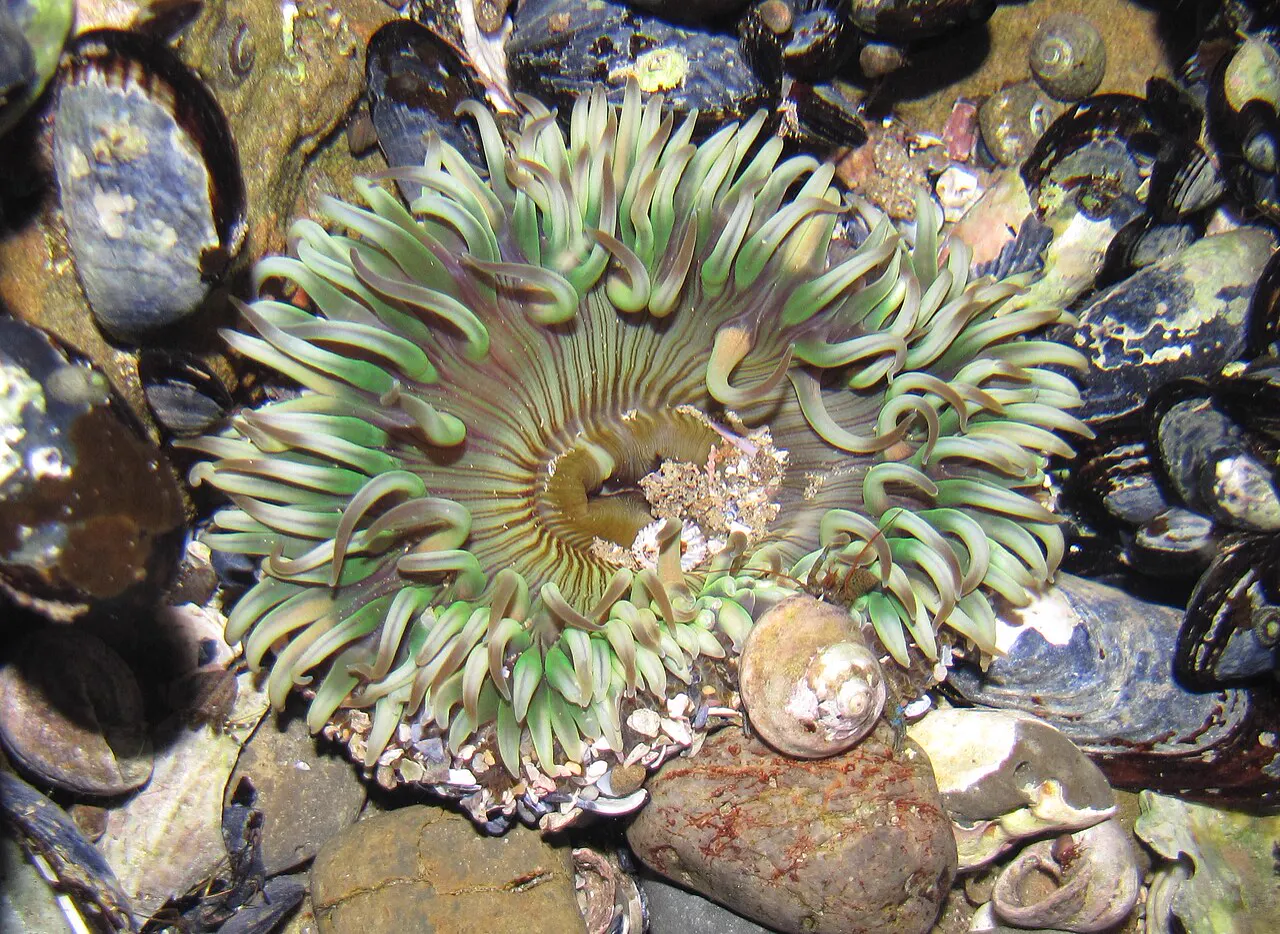
Aggregating anemones (Anthopleura elegantissima) a few inches under water at low tide, with mussels and a hermit crab

Aggregating anemone

Anthopleura elegantissima1

  • The aggregating anemone ranges from Alaska to Baja California, and the solitary anemone from central California to Baja California.1

Learn more: our aggregating anemone page · Wikipedia: Aggregating anemone (opens in a new tab)

Photo: Davefoc (opens in a new tab) · CC BY-SA 3.0 (opens in a new tab), resized
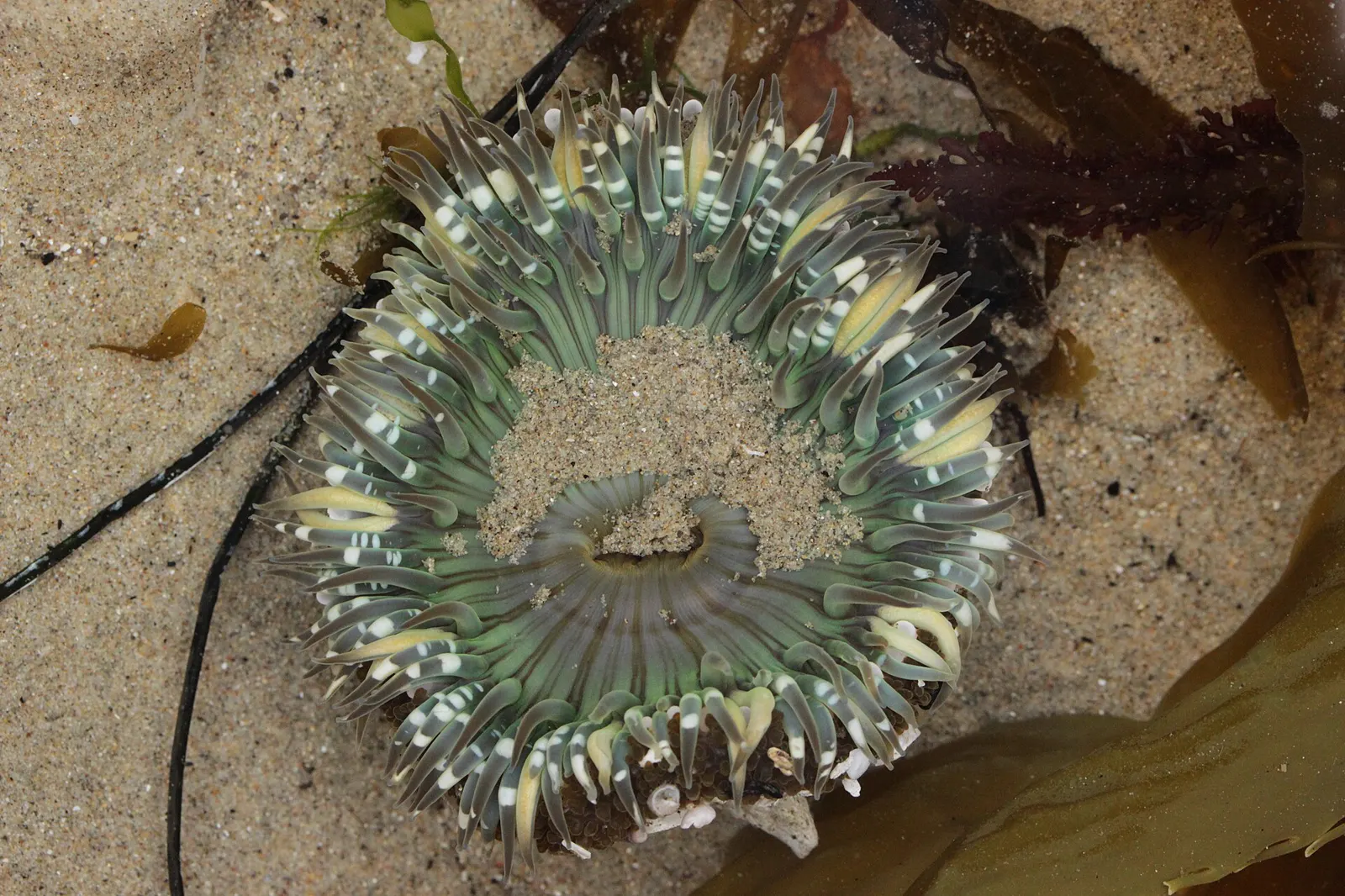
Solitary anemone (Anthopleura sola)

Solitary anemone

Anthopleura sola4

  • The solitary anemone is the largest anemone in Southern California and can reach 10 inches across.4
  • The aggregating anemone ranges from Alaska to Baja California, and the solitary anemone from central California to Baja California.1

Learn more: Wikipedia: Starburst anemone (opens in a new tab)

Photo: Björn S... (opens in a new tab) · CC BY-SA 2.0 (opens in a new tab), resized

What it looks like

  • At low tide they fold up into small blobs covered in sand and shell bits, which keeps them from drying out.3

Where and when to find it

  • Anemones mostly live in tidepools and the middle intertidal zone, where water is more plentiful.3
  • The National Park Service lists anemones among the animals of the middle intertidal zone.5
  • Anthopleura anemones are abundant on rocks, in tidepools and crevices, and on pier pilings, and are typical of the middle intertidal on semi-protected rocky shores.1

How it lives

  • Their tentacles catch and paralyse small animals and pull them to the central mouth to be digested.2
  • Anemones host single-celled algae that provide them with energy.3
  • Anthopleura anemones withstand sand scouring and can stretch their columns to push their tentacles clear of shallow sand.1

How to watch without harming it

  • Touch tidepool animals very gently, and never poke anemones.5
  • Touch only with two fingers, and avoid disturbing the places animals live.4
  • Closed anemones can be so small that you may not notice them unless you look closely.3
  • Watch where you step, and never remove animals from where they live.5

Where the agencies name them

Spots whose managing agency lists sea anemones for that place.

Further reading

For exploring further. These pages are not sources for the facts above; those are listed under Sources.

Sources

  1. MARINe (Multi-Agency Rocky Intertidal Network), UC Santa Cruz: Anthopleura (Anemones) (opens in a new tab) · page updated 23 July 2025 · accessed 17 November 2026
  2. National Park Service, Channel Islands National Park: Anemone (opens in a new tab) · page updated 21 May 2021 · accessed 17 November 2026
  3. National Park Service, Klamath Inventory and Monitoring Network: On the Edge: The Curious Lives of Intertidal Organisms and How We Monitor Them (opens in a new tab) · page updated 28 November 2022 · accessed 17 November 2026
  4. National Park Service, Cabrillo National Monument: Intertidal Field Guide (opens in a new tab) · page updated 25 June 2021 · accessed 17 November 2026
  5. National Park Service: Cabrillo National Monument: The Rocky Intertidal Zone (opens in a new tab) · page updated 31 October 2026 · accessed 17 November 2026

Last checked 17 November 2026 against the sources above.